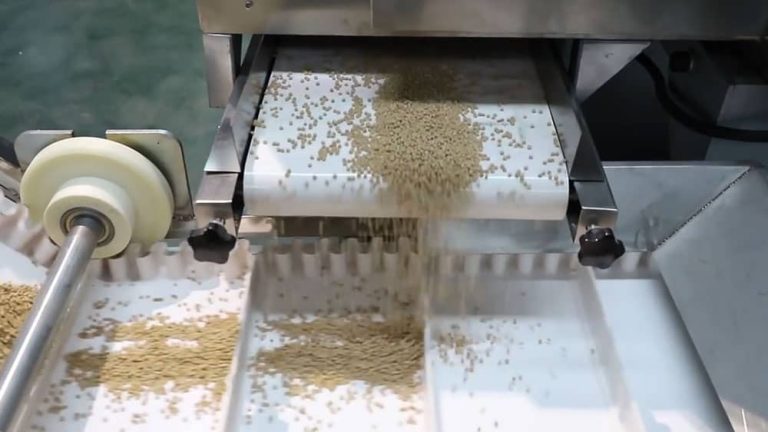
The Flexibility Challenge in Commercial Aqua Feed Manufacturing
In the modern aquaculture equipment sector, commercial feed mills face a constant dilemma: purchasing dedicated, separate production lines for floating fish feeds (such as tilapia, catfish, and carp) and sinking feeds (such as trout, salmon, and shrimp) requires double the Capital Expenditure (CAPEX) and massive factory floor space. Today’s competitive feed producers require a single, flexible twin-screw extrusion line capable of rapidly switching between high-expansion floating pellets and high-density sinking pellets with minimal transition waste.
Controlling whether an extruded pellet floats or sinks is fundamentally a thermodynamics problem of regulating **bulk density** ($g/L$) and internal microscopic steam cell expansion. By managing Specific Mechanical Energy (SME), pre-conditioner steam ratios, barrel temperature profiles, and die plate backpressure, process operators can achieve precise density control on a single Zhuoheng twin-screw processing platform.
Key Takeaways / TL;DR
- Bulk Density Thresholds: Floating feeds require a low bulk density of 360 – 480 g/L (achieved via high flash steam expansion), whereas sinking feeds demand a dense matrix of 550 – 680 g/L (achieved by suppressing steam expansion).
- SME & VFD Speed Modulation: Lowering screw RPM via Delta Variable Frequency Drives (VFDs) reduces mechanical shear, enabling the dense dough structure necessary for sinking feed without scorching delicate marine proteins.
- Rapid SOP Line Switching: Transitioning between floating and sinking formulations takes under 30 minutes by adjusting barrel heating zone setpoints, changing die orifice open areas, and dialing in preconditioner steam-to-water ratios.
1. Physical Mechanism: Controlling Expansion Ratio and Bulk Density
Whether a feed pellet floats or sinks depends on its internal void fraction (cellular air pockets created during flash evaporation at the die face):
- Floating Feed Mechanism: High barrel temperatures (120°C–140°C) and high screw shear (high SME) superheat internal dough moisture above boiling point. As dough exits the pressurized die into atmospheric pressure, superheated water instantly flashes into steam, expanding the starch matrix into closed-cell micro-bubbles that trap air and lower pellet density below 1.0 g/cm³ ($<480\ g/L$).
- Sinking Feed Mechanism: Operating at lower die temperatures (90°C–110°C) and higher moisture ratios (25%–28%) keeps internal steam pressure below the flash expansion threshold. The dense starch/protein polymer collapses slightly upon die exit, maintaining a high density above 1.1 g/cm³ ($>550\ g/L$) that sinks rapidly in freshwater and seawater.
2. Standard Operating Procedure (SOP): Floating vs. Sinking Parameter Matrix
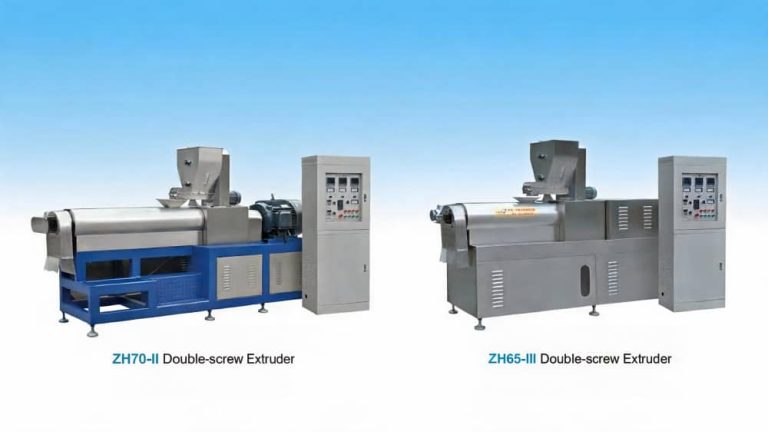
The following technical parameter matrix outlines the exact operational setpoints used on Zhuoheng Heavy-Duty Twin-Screw Extrusion Lines (such as the ZH85 and ZH95 platforms) to transition between floating and sinking aqua feeds.
| Process Parameter | Floating Aqua Feed Protocol | Sinking Aqua Feed Protocol |
|---|---|---|
| Target Bulk Density | 360 – 480 g / L (Floating >98%) | 550 – 680 g / L (100% Sinking) |
| Preconditioner Moisture | 18% – 22% (Higher Steam Ratio) | 25% – 28% (Higher Water Ratio) |
| Metering Barrel Temp Zone | 120°C – 140°C (High Heat) | 90°C – 110°C (Cooling/Controlled) |
| Main Screw Speed (RPM) | High (280 – 350 RPM via VFD) | Low – Medium (180 – 240 RPM) |
| Specific Mechanical Energy (SME) | High (28 – 36 kWh / Ton) | Low – Medium (18 – 24 kWh / Ton) |
| Die Plate Orifice Area | Restricted (High Backpressure) | Expanded Open Area (Lower Pressure) |
| Starch Gelatinization & Stability | ≥ 90% (12–24 Hour Water Stability) | ≥ 85% (High Water Durability) |
3. Key Hardware Enabling Dual-Mode Flexibility
Achieving stable dual-mode production on a single line requires specialized extrusion engineering components:
- Biaxial Differential Preconditioner: Zhuoheng’s twin-shaft differential conditioner features dual independent drives that pre-cook starch and hydrate high-protein meals (fish meal, soy protein concentrate) up to 85°C–95°C before entering the extruder. This ensures thorough starch gelatinization without relying purely on mechanical screw shear.
- 38CrMoAl Nitrided Modular Screw Profile: Co-rotating twin screws constructed with modular kneading blocks allow operators to reconfigure shear zones. For high-sinking feeds containing high lipid levels, gentle conveying elements prevent oil separation and screw slipping.
- Precision Die & Cutter Assembly: Outfitted with frequency-controlled variable speed knives, operators can adjust cutter head rotation to achieve precise pellet length-to-diameter ratios across sizes ranging from 1.5mm to 12mm.
Frequently Asked Questions (FAQ)
1. Can I produce sinking shrimp feed on the same line used for floating tilapia feed?
Yes. By installing a high-open-area die plate, reducing main motor RPM via the Delta VFD, and increasing moisture injection in the preconditioner to 26%–28%, the extruder suppresses expansion, yielding dense sinking shrimp pellets with excellent water stability.
2. How long does it take to change over from floating feed to sinking feed production?
On a Zhuoheng flexible line, a complete formulation changeover takes approximately 20 to 30 minutes. Operators purge the barrel with raw mash, swap the die plate if switching pellet diameters, and adjust the barrel temperature and VFD speed setpoints via the Siemens PLC touch screen.
3. Does sinking feed require higher oil or lipid levels?
Sinking feeds for carnivorous species (like salmon or trout) typically contain higher fat content (15% to 25%). High oil levels naturally reduce expansion by lubricating the dough melt inside the barrel, which further assists in maintaining high pellet density.
Upgrade Your Feed Mill to Flexible Extrusion Architecture
Eliminate unnecessary equipment duplication and maximize your factory’s operational ROI. Zhuoheng’s turnkey twin-screw extrusion systems deliver seamless dual-capability for floating and sinking aqua feeds. Contact our process engineering team today to receive CAD plant layouts, formulation support, and a factory-direct quotation.