The Hidden Operational Crisis in Modern Aqua Feed Manufacturing
In the highly competitive global aquaculture sector, raw material price volatility and soaring electricity tariffs present continuous threats to feed mill profitability. For plant owners and chief engineers, the initial purchase price (CAPEX) of an extrusion line represents only 15% to 20% of its Total Cost of Ownership (TCO) over a 5-year operational lifecycle. The remaining 80%+ is consumed by ongoing operational expenditure (OPEX)—primarily electrical energy consumption, wear-part replacements, and catastrophic unscheduled production downtime.
When processing modern high-protein, high-fat floating and sinking fish feeds, traditional extruders operating at fixed motor speeds suffer from severe energy throttling and accelerated mechanical degradation. This engineering report provides a concrete, data-backed guide on how feed mills can slash their 5-year TCO by up to 30% utilizing advanced Variable Frequency Drives (VFDs) and premium 38CrMoAl nitrided alloy metallurgy.
Key Takeaways / TL;DR
- Substantial Energy Savings: Integrating Delta Variable Frequency Drives (VFDs) adjusts motor speed dynamically to recipe rheology, cutting power consumption by 18%–25% annually under Affinity Law principles.
- Extended Wear Life: Utilizing 38CrMoAl alloy steel with deep nitriding treatment increases screw and barrel operational lifespan to 2,000+ hours, reducing spare parts replacement frequency by over 60%.
- Grid & Motor Protection: VFD-enabled “soft-starts” eliminate destructive current surges (up to 6x running current), protecting plant electrical grids and preventing sudden mechanical motor failures.
1. Electrical Energy Optimization: The Physics of VFD Savings
Traditional fixed-speed extruders run their main drives at 100% nominal speed regardless of formulation requirements. Operators adjust shear or throughput mechanically using dampers or restrictor valves, wasting massive amounts of electric power as heat and friction.
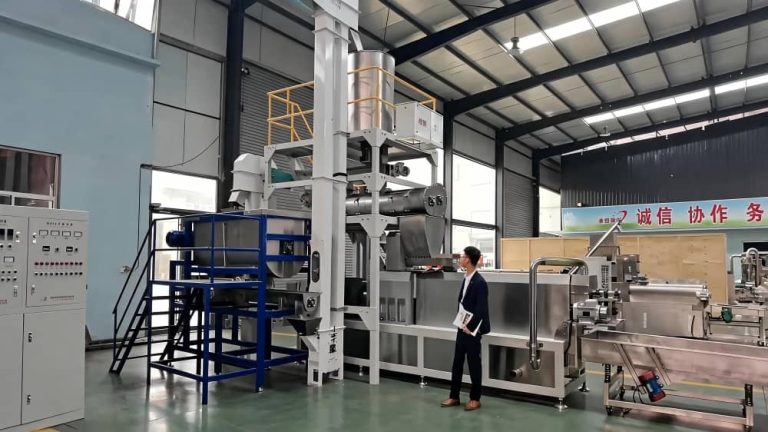
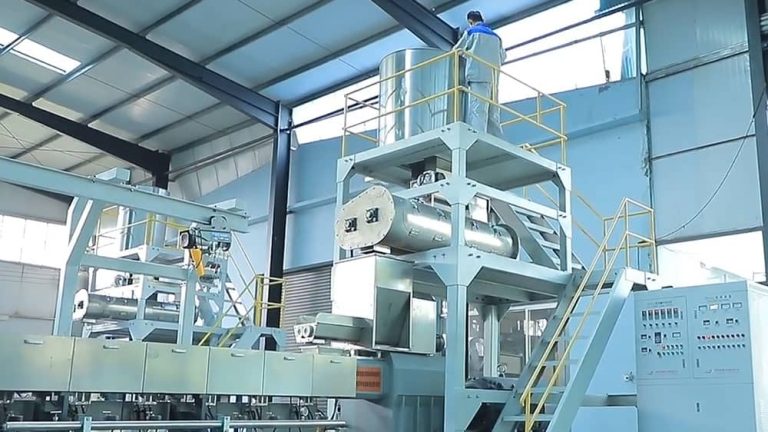
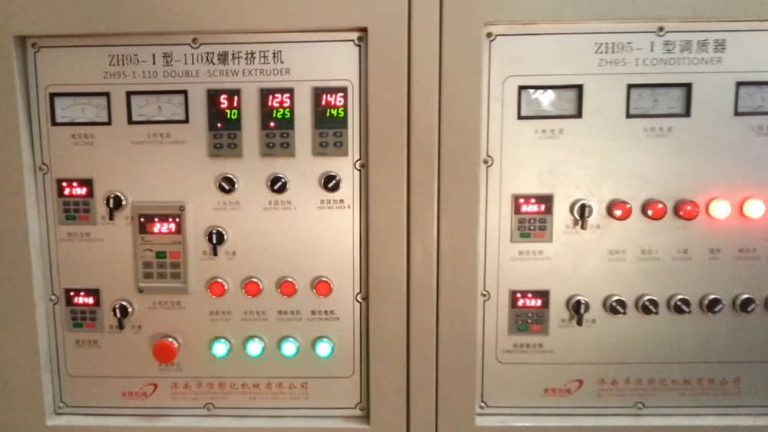
Zhuoheng twin-screw extrusion systems integrate high-performance Delta VFDs (or optional Siemens/ABB drives) linked to automated PLC touch-screen controls. By governing the frequency and voltage supplied to the main motor, the system aligns rotational torque exactly with the Specific Mechanical Energy (SME) required by the material matrix.
The Mathematical Reality of Savings (Affinity Laws)
According to fluid and rotational dynamics, motor power consumption varies with the cube of the rotational speed (P₂ = P₁ × (N₂/N₁)³):
- Running an extrusion motor at 85% speed during lower-shear formulations reduces power consumption to 0.85³ = 61.4% of peak power—yielding an immediate 38.6% drop in energy use for that batch.
- Across a standard 1 Ton/Hour line operating 4,800 hours annually, a modest average power reduction of 22 kW translates directly to 105,600 kWh saved per year.
2. Metallurgical Resistance: 38CrMoAl Nitrided Screw & Barrel Longevity
Aqua feed formulations heavily utilize abrasive ingredients such as fish bone meal, crustacean shells, and mineral premixes. Under high-pressure and high-temperature extrusion, standard carbon steel or basic stainless screws experience severe surface erosion within months.
As screw clearance increases due to wear, internal material slippage occurs, causing a sharp drop in throughput, incomplete starch gelatinization (<70%), and poor water stability in floating pellets. Zhuoheng combats this by forging all modular screw elements and barrel liners from high-grade 38CrMoAl alloy steel, subjected to a multi-stage thermal nitriding process:
- Surface Hardness: Achieves HV ≥ 950–1100 (Rockwell HRC 65+), creating an impenetrable protective layer against abrasive wear.
- Nitriding Depth: 0.5mm – 0.8mm deep nitriding ensures the screws retain precise tolerances for over 2,000 to 3,000 operational hours even under aggressive formulations.
- Self-Cleaning Geometry: The co-rotating, tightly intermeshing screw profile wipes the barrel walls continuously, preventing localized material buildup, scorching, and corrosion.
3. Concrete 5-Year TCO Financial Calculation Table
The following comparative calculation models the 5-year financial performance of a standard 1 Ton/Hour Aqua Feed Line (110 kW Main Motor, operating 16 hours/day, 300 days/year = 4,800 hours/year) at a global average industrial electricity rate of $0.12 / kWh.
| TCO Metric (5-Year Lifecycle) | Standard Extruder (Fixed Speed & Standard Steel) | Zhuoheng Line (Delta VFD & 38CrMoAl Nitrided Steel) | 5-Year Net Financial Savings |
|---|---|---|---|
| Annual Electricity Consumption | ~528,000 kWh ($63,360 / year) | ~401,280 kWh ($48,153 / year via VFD) | $76,035 USD Saved (Energy) |
| Screw & Barrel Replacements | 8–10 Sets ($32,000 total @ $3,500/set) | 2–3 Sets ($10,500 total @ $3,500/set) | $21,500 USD Saved (Parts) |
| Unscheduled Downtime Loss | Est. 120 Hours (~$24,000 lost margin) | Est. 30 Hours (~$6,000 lost margin) | $18,000 USD Saved (Downtime) |
| Starch Gelatinization Rate | Degrades to 70%–75% over time | Sustained >90% gelatinization | Higher Feed Price & Quality Retention |
| Total Estimated 5-Year Savings | Baseline High OPEX | Optimized Low TCO Architecture | +$115,535 USD Saved Net |
Frequently Asked Questions (FAQ) About Extrusion TCO
1. How fast does a Delta VFD setup pay for itself in an aqua feed plant?
Based on continuous industrial operation (16–24 hours/day), the electrical energy savings generated by Delta VFD drives typically recoup the initial premium cost of the VFD hardware within 10 to 14 months of production.
2. Why is 38CrMoAl nitrided steel better than standard stainless steel for screws?
While standard stainless steel (like SS304) offers good rust protection, its surface hardness is relatively low (HRC 20–25), making it wear down rapidly against abrasive fish meal and bone powder. 38CrMoAl with nitriding treatment provides extreme surface hardness (HRC 65+), offering superior resistance against severe mechanical abrasion while maintaining structural toughness.
3. How do VFD soft-starts protect my factory’s electrical grid?
Direct-on-line motor starts generate massive electrical current spikes—up to 600% of nominal running current—which can trip main breakers, damage transformer windings, and incur peak-demand utility penalties. A VFD gradually ramps up motor frequency from 0Hz to 50/60Hz, executing a smooth “soft start” with zero current spikes.
Upgrade Your Plant for Maximum Operational Profitability
Lowering your feed mill’s Total Cost of Ownership is not merely about buying cheaper machinery; it is about investing in intelligent engineering that minimizes lifetime energy waste and component wear. Contact Zhuoheng’s engineering team today to receive a customized plant layout, ROI calculation, and turnkey quote for your factory.