The Hidden Cost of Industrial Extrusion: Energy Consumption
For commercial snack food, pet food, and industrial feed manufacturers, electricity constitutes one of the largest ongoing operational expenses (OPEX). Traditional extrusion lines often operate their massive main drive motors, feeder screws, and high-speed rotary cutters at fixed speeds. To adjust production throughput, operators historically relied on mechanical dampers, gearbox ratio changes, or flow restriction valves. This archaic method wastes staggering amounts of energy as excess heat, friction, and mechanical stress.
Key Takeaways / TL;DR
- Radical Cost Reduction: Integrating advanced Variable Frequency Drives (VFDs) into extrusion lines can slash overall electrical power consumption by 20% to 30%.
- Motor and Grid Longevity: VFDs facilitate gentle “soft starts,” preventing massive electrical inrush surges that degrade motors and stress the factory’s grid infrastructure.
- Unmatched Process Stability: Infinite, precise speed control ensures consistent Specific Mechanical Energy (SME) input, directly resulting in uniform product expansion, texture, and quality.
The Zhuoheng Intelligent VFD Engineering Solution
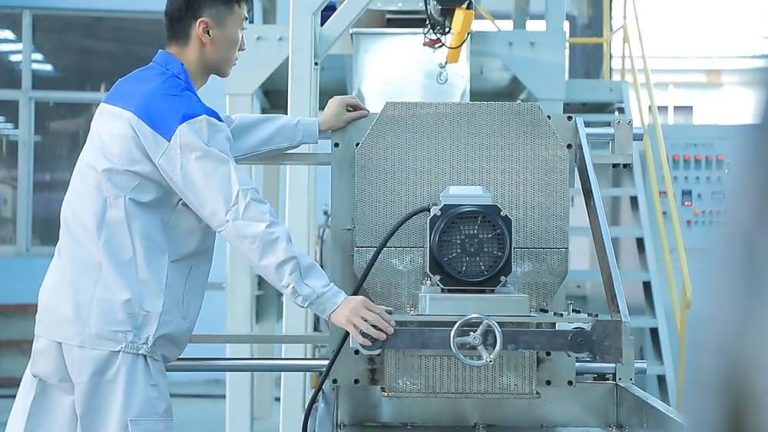
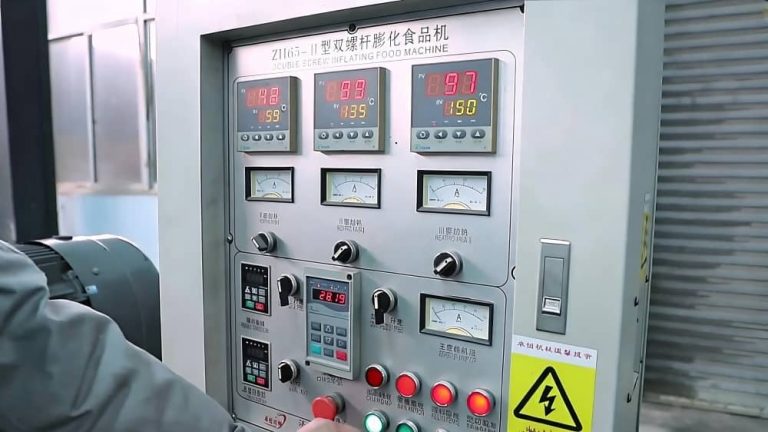
To maximize the Return on Investment (ROI) for our global partners, modern heavy machinery must be inherently energy-efficient. Zhuoheng Extrusion Machinery rigorously integrates globally recognized Variable Frequency Drives (partnering with tier-one brands like Delta, ABB, and Siemens) across all critical kinetic components.
The Fluid Dynamics of Energy Savings (The Affinity Laws)
The energy savings provided by VFDs are not merely theoretical; they are rooted in the physical laws of fluid and rotational dynamics, specifically The Affinity Laws. In motor-driven systems, power consumption relates to operational speed by a cubic inverse proportion:
P₂ = P₁ × (N₂ / N₁)³
This mathematical reality reveals highly compelling cost-saving figures for factory managers:
- If you reduce the motor speed by just 10% (N₂/N₁ = 0.9), the required power consumption drops to 0.9³ (72.9%). This instantly yields an energy saving of over 27%.
- If production requirements allow a speed reduction of 20% (N₂/N₁ = 0.8), the power consumption plummets to 0.8³ (51.2%), yielding nearly a 49% reduction in energy costs.
Operational Advantages Beyond Power Savings
- Demand-Based Power Allocation: VFDs intelligently adjust the motor’s RPM and voltage to match the exact rheological load required by the specific formula inside the barrel.
- Eliminating Current Spikes: Starting a massive 132kW or 160kW direct-on-line motor induces a violent power spike—often up to 6 times the normal running current. VFDs mitigate this by slowly ramping up the frequency, executing a “soft start” that protects your factory’s electrical grid.
- Synchronized PLC Production: Our integrated PLC and Touch Screen systems interlock the feeder VFD with the main motor VFD. If the feeding rate fluctuates, the main screw adjusts synchronously, preventing catastrophic barrel blockages.
Energy Consumption Comparison (Based on a 1 Ton/Hour Line)
| Performance Metric | Traditional Extruder (Fixed Speed) | Zhuoheng Extruder (VFD Equipped) |
|---|---|---|
| Startup Current Surge | Extreme (Causes severe grid strain) | Minimal (Controlled soft start) |
| Average Running Power | Always 100% of rated capacity | Dynamically adjusts to 70% – 85% |
| Specific Mechanical Energy (SME) | Fluctuating and inconsistent | Highly precise and stable |
| Mechanical Wear & Tear | High (Constant peak stress) | Low (Torque is optimized to load) |
Invest in Sustainable, Profitable Manufacturing
Upgrading to a VFD-controlled twin-screw extrusion line from Zhuoheng is more than a nod to environmental sustainability; it is a direct, measurable enhancement to your bottom line. For high-capacity plants, the cumulative electricity savings typically pay for the premium cost of the VFD components within the very first 12 to 18 months of operation.