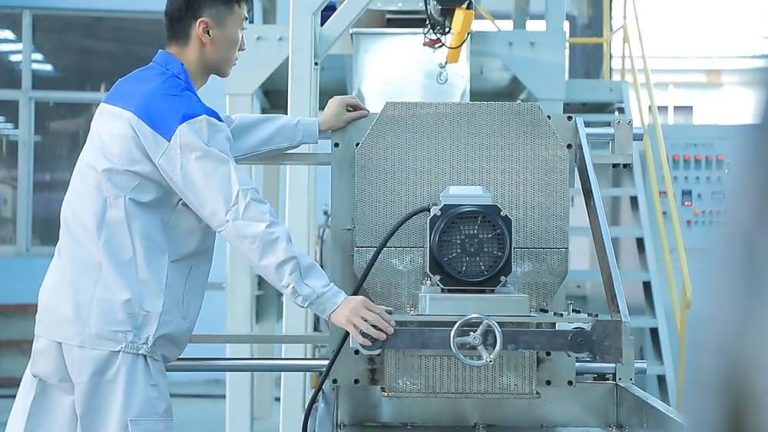
The Physics of Defect Elimination in High-Speed Food Extrusion
In modern industrial food, pet food, and aqua feed manufacturing, extrusion is a high-shear, high-temperature, short-time (HTST) thermodynamic process. When operating a continuous twin-screw production line at throughputs ranging from 500 kg/h to over 3,000 kg/h, minor fluctuations in raw material rheology, moisture content, or barrel temperature profiles can instantly cascade into finished pellet defects.
Pellet defects—such as fragile, easily crushed kibbles, low expansion bulk density failures, or excessive fines—do not merely degrade brand reputation; they directly inflate manufacturing scrap rates and reduce overall line efficiency. Resolving these issues requires a systematic diagnostic framework based on balancing Specific Mechanical Energy (SME), thermal energy input, moisture ratio, and die backpressure.
Key Takeaways / TL;DR
- SME & Thermal Energy Balance: Adjusting main screw RPM via Variable Frequency Drives (VFDs) changes the Specific Mechanical Energy ($SME = \frac{2\pi \cdot \tau \cdot N}{\dot{m}}$), governing starch gelatinization without overheating delicate proteins.
- Moisture Control Window: Maintaining preconditioner moisture at a tight 22%–26% range prevents both dough elasticity collapse (over-moisture low expansion) and flash evaporation rupture (under-moisture fragile kibble).
- Precision Cutting & Clearance: Surface roughness and “angel hair” fines are overwhelmingly caused by worn cutter blades or incorrect blade-to-die clearances exceeding 0.1 mm.
1. Understanding Specific Mechanical Energy (SME) vs. Thermal Energy
To troubleshoot any food or feed extruder effectively, process engineers must distinguish between mechanical dissipation and thermal transfer:
- Specific Mechanical Energy (SME): The mechanical power transmitted to the dough melt by the main motor per unit of mass flow (expressed as $kWh/ton$ or $kJ/kg$). Increasing screw speed (RPM) increases shear rate, breaking down starch molecular chains and raising melt temperature internally.
- Thermal Energy ($Q_{thermal}$): Heat added externally via barrel heating jackets or direct steam injection in the pre-conditioner. Thermal energy cooks the starch matrix gently without degrading heat-sensitive vitamins, lipids, or animal proteins.
When Troubleshooting, adjusting screw speed via Delta VFD controls alters SME within seconds, making it the primary lever for fine-tuning expansion, density, and crispness on the factory floor.
2. The 7 Common Pellet Defects & Root Cause Diagnostic SOP
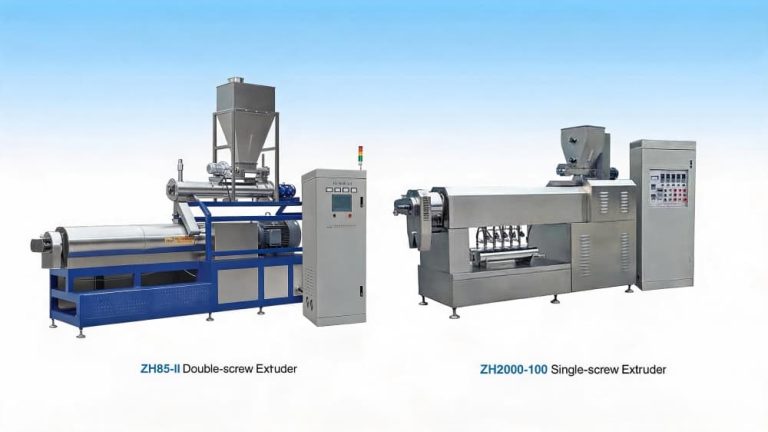
Below is the standardized engineering troubleshooting matrix used by plant technicians and quality assurance teams operating Zhuoheng twin-screw extrusion systems.
| Defect Symptom | Primary Root Cause | Physical / Chemical Mechanism | Recommended Corrective Action |
|---|---|---|---|
| 1. Low Expansion / High Density Kibble | Insufficient SME or excessive moisture (>22%) | Over-moisture lubricates dough, reducing friction; starch fails to melt and gelatinize (<80%). | • Increase screw RPM (+10%–15%) • Raise metering zone temp (+10°C) • Reduce barrel water injection |
| 2. Fragile / Easily Broken Kibble (High Fines) | Excessive SME or insufficient moisture (<15%) | Extreme flash evaporation at die face ruptures cellular starch walls, creating hollow, brittle structures. | • Reduce main drive RPM via VFD • Increase preconditioner steam • Lower final barrel zone temp |
| 3. Surface Roughness & “Angel Hair” Fines | Dull cutter blades or incorrect blade clearance | Dough melt is torn rather than cleanly sheared at die exit; uneven flow velocity across die holes. | • Reset blade clearance to 0.05–0.1 mm • Replace worn 38CrMoAl die inserts • Clean blocked die orifices |
| 4. Inconsistent Bulk Density (Floating/Sinking Failure) | Unstable pre-conditioner steam/water ratio | Fluctuating dough gelatinization (<85%) causes density variations across batches. | • Stabilize preconditioner steam at 0.2–0.4 MPa • Check feeder screw calibration • Lock VFD speed setpoints |
| 5. Deformed “Dog Bone” or Tailed Pellets | Improper cutter speed relative to mass flow | Pellet stringing occurs when melt viscosity is too high or knife cutting frequency is out of sync. | • Increase cutter head VFD speed • Raise die zone temperature (+5°C–10°C) to lower melt viscosity |
| 6. Post-Drying Kibble Cracking / Splitting | Thermal shock in multi-layer belt dryer | Rapid moisture loss creates steep internal moisture gradients, causing stress fractures. | • Lower initial dryer zone temp • Increase extruder pre-gelatinization • Extend drying residence time |
| 7. Scorched Spots / Dark Discoloration | Localized thermal degradation / stagnation | High shear in discharge zone burns residual sugars/proteins; material hangs up in dead spots. | • Reduce final zone temp (<150°C) • Inspect screw element clearances • Purge and clean barrel assembly |
3. Step-by-Step Operator Adjustment Protocol
When an operator notices pellet quality drifting out of specification, making multiple simultaneous parameter changes makes it impossible to isolate the root cause. Follow this strict single-variable diagnostic sequence:
- Check Preconditioner Discharge: Verify that raw mash exiting the preconditioner reaches 85°C–95°C and possesses a uniform, clump-free moisture consistency before entering the extruder feed throat.
- Monitor Main Motor Torque %: Inspect the Siemens PLC touch screen. Motor torque should remain stable within 65%–80% of nominal capacity. Torque spikes indicate dry dough or cold barrel zones; surging torque indicates feeder bridging.
- Adjust Screw RPM First: Use the Delta VFD main drive speed control to adjust SME. To increase expansion and crispness, raise RPM by 5% increments. Allow 3 to 5 minutes for the material residence time to stabilize before evaluating new samples.
- Fine-Tune Barrel Temperature Profile: Adjust the final discharge zone temperature in 5°C increments. Higher temperature lowers melt viscosity at the die, increasing steam flash expansion while reducing motor load.
Frequently Asked Questions (FAQ)
1. Why is my pet food kibble breaking easily inside the packaging bag?
Kibble friability is typically caused by over-expansion (excessive SME or superheated steam) resulting in cell walls that are too thin to withstand transport shock. To fix this, reduce main screw RPM via your VFD or slightly increase feed water injection to lower the expansion ratio and thicken the cell walls.
2. How does starch gelatinization affect pellet structural strength?
Starch acts as the primary binder in extruded formulations. Achieving a starch gelatinization degree above 90% ensures that starch polymers fully hydrate, melt, and form a continuous matrix that traps fat and protein molecules, yielding high mechanical durability (PDI > 98%).
3. How often should extruder die plates and cutter blades be inspected?
In high-throughput 24/7 processing environments, cutter blades should be inspected every shift and resharpened or replaced if burrs develop. Die plates manufactured from 38CrMoAl nitrided alloy should be measured monthly with calipers to ensure orifice diameters have not enlarged by more than 0.2 mm due to wear.
Standardize Your Production Line for Zero Defect Output
Eliminating product defects and maximizing uptime requires a combination of operator training and reliable machinery. Zhuoheng’s twin-screw extruders feature automated Siemens PLC diagnostics, Delta VFD speed controls, and heavy-duty 38CrMoAl nitrided screw elements designed for continuous precision. Contact our technical engineering team today for custom formulation assistance, troubleshooting support, or plant equipment upgrades.