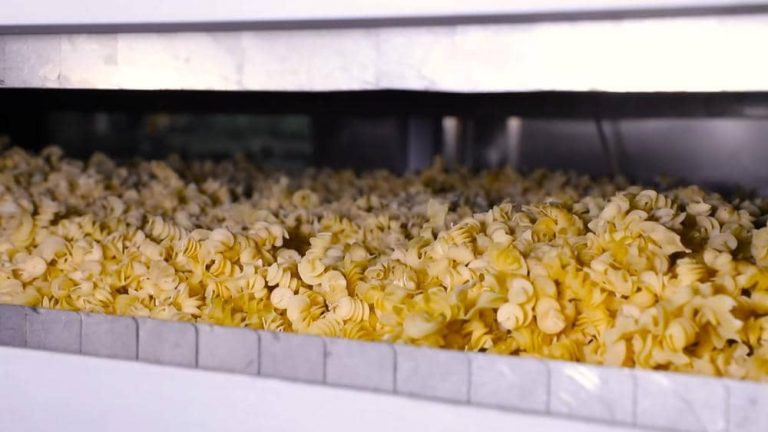
Drying Thermodynamics for Macaroni & Pasta: Controlling Moisture Gradient to Prevent Product Cracking
Industrial macaroni and pasta extrusion produces dense, high-gluten shapes that require sophisticated moisture removal. While single-screw vacuum extrusion establishes the initial structural density, the final quality of commercial pasta is determined inside the drying oven. Improper drying parameters trigger internal moisture gradients, generating thermal and mechanical stresses that cause checking (micro-cracking) during storage or boiling collapse in commercial kitchens.
Key Takeaways / TL;DR
- Moisture Gradient Management: Stress checking occurs when surface water evaporates faster than internal moisture diffuses to the exterior, creating high internal tension.
- Multi-Stage Zoned Drying: Zhuoheng’s ZHKX series multi-layer dryers utilize 3-stage thermodynamic profiling (Pre-drying, Main Drying, and Moisture Equalization) to maintain continuous vapor equilibrium.
- Boiler-Free Energy Efficiency: Advanced heat exchanger integration and recirculation air technology cut thermal energy consumption by 25% while maintaining precise ±1°C zone control.
The Physics of Moisture Migration and Stress Checking
Extruded semolina pasta enters the drying stage with a moisture content of approximately 28% to 31%. To achieve commercial shelf stability, this moisture must be reduced to a precise final threshold of 12.5% to 13.0%. If dry hot air is applied aggressively at high velocities, the outer layer of the pasta rapidly dehydrates and forms a rigid, glassy skin, while the core remains moist and expanded.
This imbalance establishes a severe moisture gradient across the cross-section. As the wet core slowly dries and shrinks over subsequent hours, it pulls against the unyielding outer shell. When internal tensile stress exceeds the tensile strength of the gelatinized starch-protein matrix, micro-fractures develop. This structural defect, known as checking, manifests as hairline cracks that cause pasta to shatter during transportation or disintegrate into a mushy consistency when cooked.
Zhuoheng ZHKX Multi-Layer Drying Engineering
To eliminate stress cracking, Zhuoheng’s ZHKX multi-layer continuous conveyor dryers control both relative humidity (RH) and temperature across dedicated thermodynamic zones:
- Stage 1: Pre-Drying (Pre-Dehydration): High-temperature (65°C – 75°C) and moderate humidity air rapidly hardens the exterior shape to prevent sticking on the conveyor belts without sealing the surface pores.
- Stage 2: Main Thermodynamic Drying: Temperature is sustained while relative humidity is elevated to 70%–80%. High ambient humidity prevents premature surface crusting, allowing moisture from the pasta core to diffuse continuously outward.
- Stage 3: Equalization & Convective Cooling: The pasta passes through a gradual cooling zone where relative humidity is reduced and ambient air is circulated, stabilizing the moisture gradient at 12.5% before packaging.
Thermodynamic Parameters for Industrial Pasta Drying
“Before upgrading to Zhuoheng’s multi-zone drying line, our macaroni line suffered a 14% loss from stress cracking during sea shipment. By controlling the relative humidity gradient in Stage 2, checking has been reduced to zero, and our pasta maintains perfect al dente bite after boiling.”
Frequently Asked Questions (FAQ)
Q1: Why does pasta crack several hours after leaving the dryer?
A1: Stress checking occurs post-drying when an unmitigated moisture gradient exists between the core and the surface. As residual moisture continues to migrate outward at ambient temperatures, internal contraction forces break the rigid surface layer.
Q2: Can Zhuoheng drying ovens operate efficiently without a steam boiler?
A2: Yes. Zhuoheng offers ZHKX dryers configured with electric, natural gas, or diesel thermal exchangers, allowing high-capacity pasta drying without requiring expensive municipal boiler permits.
Q3: How does relative humidity control prevent pasta breakage during cooking?
A3: High relative humidity in the early drying stages keeps outer starch pores open. This permits uniform moisture release, ensuring a homogeneous gluten matrix that holds its shape even after 45 minutes of boiling.
Q4: What conveyor belt material is used for food-grade safety?
A4: Zhuoheng utilizes food-grade SS304 stainless steel mesh belts or PTFE-coated heat-resistant belts, ensuring zero product contamination and easy sanitization.
Related solutions: Macaroni & Pasta Extrusion Line | Multi-Layer Continuous Drying & Roasting Ovens
Further reading: Industrial Macaroni & Pasta Line: Single-Screw Vacuum Extrusion