Is That Capacity Wet Extrudate or Saleable Product? How to Read an Extrusion Output Guarantee
When comparing technical proposals for an industrial food or feed line, buyers frequently encounter two quotations that both promise “1,000 kg/h” or “1 ton/hour” nominal capacity. Yet once the plant is commissioned, plant managers sometimes discover that the bagging scale only records 750 to 820 kg/h of finished, shelf-stable product—or that throughput drops sharply when switching from a high-starch floating recipe to a dense sinking or high-meat formula.
This gap rarely stems from a single broken component. In most cases, it comes from comparing nameplate ratings measured at different points along the production line, under different moisture bases, and without accounting for downstream thermal bottlenecks. Understanding how twin-screw extruders and downstream thermal systems interact in a complete mass balance is essential before signing any equipment contract.
Key Takeaways / TL;DR
- Measurement Point Dictates Real Output: Wet extrudate weighed at the extruder die (typically 24%–32% moisture) includes injected steam and water that must be evaporated downstream, meaning finished dry-bagged weight can be 15%–25% lower unless dry-solids mass balance is matched.
- Same Extruder, Different Line Capacities: A single extruder chassis delivers different rated outputs across applications—for example, a ZH95-I unit rated at 800–1,200 kg/h on aquafeed or pet food operates at 500–600 kg/h when configured for high-viscosity modified starch due to longer residence time requirements.
- Bind Guarantees to Full-Line FAT & SAT: Never accept a generic brochure number as a warranty; specify the buyer’s actual recipe, target moisture, bulk density, and measurement checkpoint (post-cooler/pre-bagging) during a multi-day full-line Factory Acceptance Test (FAT).
Four Measurement Points Behind a “1 Ton/Hour” Capacity Claim
An extrusion line is an open thermodynamic and mass-transfer system where water and fats are added and removed at multiple stages. Because mass changes at every unit operation, an ambiguous “1,000 kg/h” specification can legally describe four very different physical quantities:
- Dry Mash Feed Rate (Inlet Basis): The dry flour or meal blend metered from the feeder into the preconditioner, typically at 10%–12% ambient raw moisture before steam and water injection.
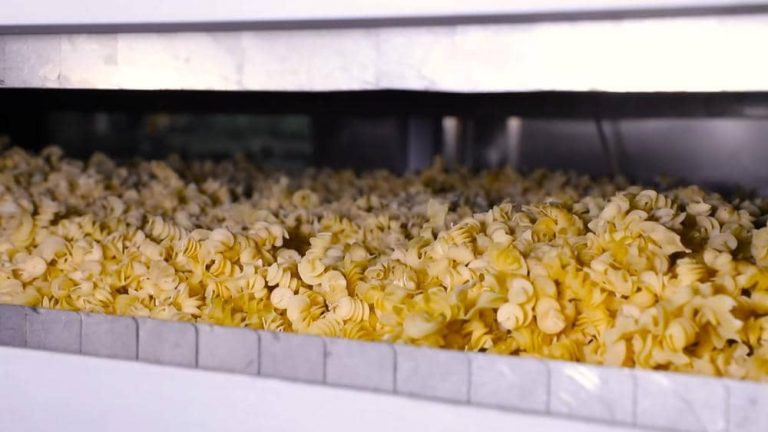
- Wet Extrudate Flow (Die-Face Basis): The hot, moist pellets or shapes exiting the die after steam preconditioning and barrel liquid addition. Depending on the product, wet extrudate moisture commonly reaches 24%–32% (and higher in wet-textured formulations).
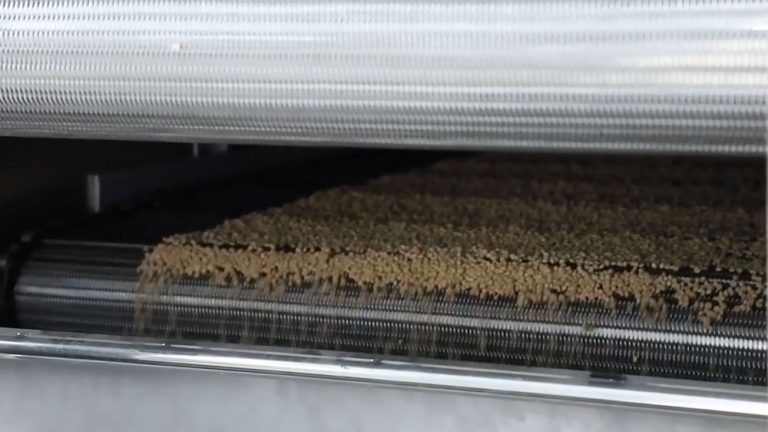
- Post-Dryer Output (Dried Basis): The product weight after passing through surface dehumidification and multi-layer dryers to reach safe commercial storage moisture—generally 8%–12% for dry pet food and aquafeed, or lower for direct-expanded snacks.
- Saleable Packaged Output (Net Bagged Basis): The final commercial weight at the bagging scale after optional post-extrusion fat/digest vacuum coating, convective cooling, and vibratory screening to remove fines or broken fragments.
The table below illustrates how a single dry-solids throughput yields completely different hourly tonnages depending on where the supplier places the scale. Note that all figures below are an Illustrative Assumption Only for mass-balance modeling; actual moisture loss and coating uptake vary by recipe and target product.
Why the Same Extruder Model Produces Different Outputs Across Lines
Buyers auditing equipment catalogs often question why the exact same extruder designation shows different throughput ranges or installed power numbers on different product pages. Rather than an error, this reflects real physical boundaries governed by screw fill degree, residence time, formulation rheology, and auxiliary equipment integration.
- Unit Configuration vs. Stand-Alone Platform: Adding a biaxial differential pre-conditioner, storage bin, and elevator changes both thermal preparation and total power accounting. In Zhuoheng’s 2026 specifications, the stand-alone ZH85-II (75 kW main motor, 97 kW unit installed power) carries a nominal rating of 400–500 kg/h for general extrusion, whereas the integrated ZH85-II large pre-conditioner unit (75 kW main motor, 110 kW installed power) is rated at 300–500 kg/h across heavy-duty pre-cooked lines. Similarly, the flagship ZH95-I (95 mm screw diameter, effective L/D ratio 19.5, 110 kW main drive motor) carries 151 kW unit installed power—or approximately 155.75 kW when all feeding, silo, and transfer auxiliaries are summed—while a complete ZH95 aquafeed line totals 296 kW installed power (with approximately 177 kW typical operating consumption).
- Formulation Rheology & Residence Time: High-starch floating fish feed expands rapidly at moderate barrel retention, allowing the ZH95 platform to run at 800–1,200 kg/h (and 1,000–1,200 kg/h in dedicated aquafeed line configurations). In contrast, high-viscosity food-grade pre-gelatinized starch or industrial paper/textile sizing starch requires sustained mechanical shear and longer barrel residence time, placing the same ZH95 frame in a 500–600 kg/h operating window.
- Micro-Pellet Die Resistance & Sinking Formulas: Switching from 4–8 mm floating carp feed to 0.8–1.5 mm sinking shrimp micro-pellets dramatically reduces open die area and increases back-pressure, while limiting expansion. High-fresh-meat pet food slurries also alter barrel friction and introduce substantial water that reduces dry-matter throughput per hour.
- Downstream Thermal & Drying Balance: Even if an extruder can mechanically push 1,200 kg/h of wet dough, finished output is capped by the drying system’s evaporation capacity. In a representative 1-ton-class system balance, a negative-pressure Surface Dehumidifier removes initial flash surface moisture (typically an illustrative 8%–10% moisture drop) before the product enters a multi-layer dryer—for instance, a 5-layer steam dryer requiring roughly 700–1,000 kg/h of steam from a buyer-provided boiler—followed by a multi-layer cooling box and, for high-fat recipes, a dual-tank Vacuum Coating System operating in alternating batches. If steam pressure or dryer retention time is undersized, operators must throttle back the extruder feeder to prevent wet cores and mold.
What Missing Data Makes Any Output Claim Unverifiable
From an engineering procurement standpoint, no supplier—and no buyer—can verify whether a line will hit its promised tonnage without locking down five missing boundary parameters. A generic “1,000 kg/h” quote leaves the contract unenforceable if any of the following inputs remain undefined:
- Exact Recipe & Grind Fineness: Protein, starch, crude fat, fiber, ash content, fresh-meat slurry moisture, and hammermill/pulverizer mesh size (such as 80–120 mesh for micro-aquafeed).
- Moisture & Bulk Density Targets: Pre-conditioned mash moisture, target finished storage moisture (e.g., 8%–12%), and target bulk density (g/L) or buoyancy rate for aquatic feeds.
- Die Geometry & Pellet Dimensions: Exact die hole diameter (mm), cut length, and open-area ratio used to establish the rated throughput.
- Local Utility & Boiler Conditions: Target industrial grid voltage and frequency (such as 380V/50Hz or customized 220V/60Hz and 460V/60Hz), ambient humidity, and available steam pressure from the buyer-provided boiler.
- Steady-State Duration: Whether the figure represents a 10-minute peak burst or continuous steady-state production across an 8-hour shift without surging or motor overload.
Engineering Verification Standard: An extrusion capacity guarantee is only commercially valid when it binds the supplier to a specific finished, dried, and cooled product weight at a defined moisture content—verified continuously on the buyer’s actual formulation during full-line Factory Acceptance Testing (FAT) and Site Acceptance Testing (SAT).
Evidence to Demand Before Signing and How to Write FAT/SAT Terms
Rather than relying on sales assurances, procurement teams and plant engineers can eliminate capacity ambiguity by requesting verifiable pre-order documentation and embedding measurable tolerances into the purchase contract. Use the verification framework below to align both parties before paying a deposit:
Frequently Asked Questions (FAQ)
Q1: Why does an extruder’s rated kg/h change when switching from floating fish feed to sinking shrimp feed or high-meat pet food?
A1: Throughput depends on screw fill efficiency, die open area, and required barrel residence time. Sinking shrimp micro-pellets (0.8–1.5 mm) create significantly higher die back-pressure, while high-fresh-meat pet food slurries reduce barrel friction and add extra water that increases downstream drying load—both reducing finished dry-matter kg/h compared to standard high-starch floating pellets.
Q2: How much capacity difference is normal between wet extrudate at the die and finished dry product?
A2: For standard dry feeds and kibbles exiting the extruder at 26%–30% moisture and dried down to 9%–11% storage moisture, evaporating water reduces mass by roughly 18%–22% before any post-extrusion fat coating is applied. Always confirm whether your quotation defines rated output on a wet die-face basis or a dried, cooled saleable basis.
Q3: Can Zhuoheng test my local raw material formula before shipment to verify actual capacity?
A3: Yes. Zhuoheng supports pre-order sample testing using raw materials or formulations shipped by the client, followed by a mandatory 3-day full-line coordinated FAT prior to shipment. Clients can inspect capacity, pellet shape, and moisture performance on-site or via live 4K video before final crating.
Q4: What happens if the extruder reaches rated output during testing, but the dryer cannot keep up?
A4: If the multi-layer dryer’s airflow, surface dehumidification, or steam supply cannot evaporate the incoming water load within the belt residence time, the entire line must be throttled down to avoid wet cores and spoilage. That is why buyers should verify integrated line mass balance and confirm boiler steam capacity (usually buyer-provided) before finalizing equipment sizing.
Related solutions: Aqua Feed Extrusion Line | Industrial Twin & Single Screw Extruders
Further reading: Why Do Extrusion Line Quotes Differ by 50%+? Purchase Price vs. TCO Guide