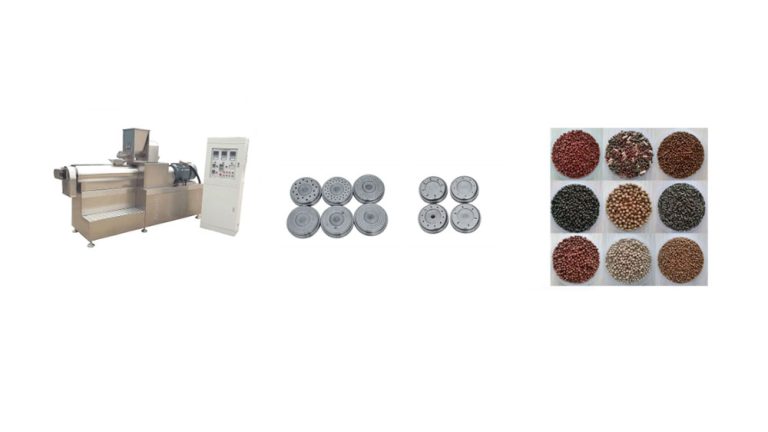
The Thermodynamic Challenge in Modern Aqua Feed Processing
In commercial aquaculture manufacturing, producing high-value aquatic feed requires absolute precision over pellet physics. Aquatic species reside in distinct water columns—surface feeders like tilapia and catfish demand high-buoyancy floating feed, while bottom-dwelling species such as trout, salmon, shrimp, and crab require dense, fast-sinking pellets [4]. For feed mill operators, the engineering challenge lies in using a single extrusion platform to dynamically regulate pellet bulk density while ensuring exceptional water stability to prevent nutrient leaching and pond pollution [1, 4, 10].
Key Takeaways / TL;DR
- Precise Density Control: By manipulating Specific Mechanical Energy (SME), barrel temperature zones, and die pressure, twin-screw extruders easily switch between floating (density < 1.0 g/cm³) and sinking (density > 1.0 g/cm³) aqua feed [2, 4, 6].
- Superior Water Stability: Twin-screw extrusion achieves a starch gelatinization rate of 85% to over 95%, guaranteeing water stability for over 12 hours without pellet disintegration [1, 5, 10].
- No Material Slippage: Intermeshing co-rotating twin screws provide a positive displacement pumping effect, effortlessly processing high-fat and high-protein marine recipes up to 22% lipids without screw stalling [3].
Extrusion Mechanics: How SME Dictates Pellet Buoyancy
Pellet expansion at the discharge die is dictated by the thermodynamic flash-off of superheated water inside the extruder barrel [6]. The key rheological parameter controlling starch matrix expansion is Specific Mechanical Energy (SME)—the mechanical work input per unit mass from the main motor [2, 3]:
SME (kWh/t) = [ Rated Power (kW) × Torque Load (%) × (Actual RPM / Rated RPM) ] ÷ Throughput (t/h)
Where P represents motor power, τ is torque load, RPM is screw speed, and ˙m is mass throughput [2]. Controlling SME dictates whether starches create porous micro-cavities or a dense, unexpanded matrix [4, 11]:
1. Floating Fish Feed Physics (High SME / High Expansion)
To produce floating pellets with an overall buoyancy rate of ≥98%, the system operates under high temperature (120°C–140°C), lower operating moisture (18%–22%), and high screw shear [1, 4, 6]. High SME breaks starch polymer chains and forces rapid steam expansion as the melt exits the die aperture [6, 11]. The sudden pressure drop creates countless internal microscopic air cells, reducing pellet density well below 1.0 g/cm³ so it floats continuously on the water surface [4].
2. Sinking Fish Feed Physics (Low SME / High Density)
Producing sinking feed (such as shrimp or trout diets) requires preventing steam expansion while achieving complete cooking [4, 6]. Zhuoheng twin-screw extruders achieve this by increasing operational moisture (25%–28%), reducing die zone temperatures (80°C–100°C), and utilizing low-shear screw element profiles [3, 6]. Moisture acts as a plasticizer, lowering melt viscosity and friction [6, 12]. The material exits the die as a dense, glassy structure without micro-cavities, ensuring bulk density exceeds 1.2 g/cm³ for rapid sinking [4, 6, 13].
Process Parameter Comparison Matrix
| Processing Parameter | Floating Fish Feed | Slow-Sinking Feed | Fast-Sinking Feed (Shrimp/Trout) |
|---|---|---|---|
| Target Bulk Density | 400 – 480 g/L (< 1.0 g/cm³) [4] | 500 – 560 g/L (~ 1.0 g/cm³) | 600 – 680 g/L (> 1.2 g/cm³) [4] |
| Barrel Temperature | 120°C – 140°C [4] | 100°C – 115°C | 80°C – 100°C [4] |
| In-Barrel Moisture | 18% – 22% [6] | 22% – 25% | 25% – 28% [6] |
| Specific Mechanical Energy | High (≥ 80 kWh/t) [5] | Medium (50 – 70 kWh/t) | Low (30 – 45 kWh/t) [5] |
| Starch Gelatinization | 85% – 95%+ [1, 5] | 85% – 90% [5] | 80% – 88% [5] |
| Water Stability Duration | ≥ 12 Hours [1, 10] | ≥ 12 Hours [1] | ≥ 2 – 12 Hours [5] |
Metallurgy & Wear Life: 38CrMoAl Alloy Protection
Aqua feed formulations heavily incorporate abrasive raw materials such as fish bone meal and crustacean shells [3, 14]. Under continuous high-pressure conditions, standard steel barrels experience severe abrasive wear [3, 15]. Zhuoheng manufactures all core screws and barrel liners from premium 38CrMoAl alloy steel treated with deep gas nitriding [1, 3]. This achieves a surface hardness of ≥HV850 and a nitrided case depth of 0.5–0.8mm, extending component wear life to over 8,000 continuous operating hours under industrial loads [10].
Frequently Asked Questions (FAQ)
Q1: Can one Zhuoheng twin-screw line produce both floating and sinking fish feed?
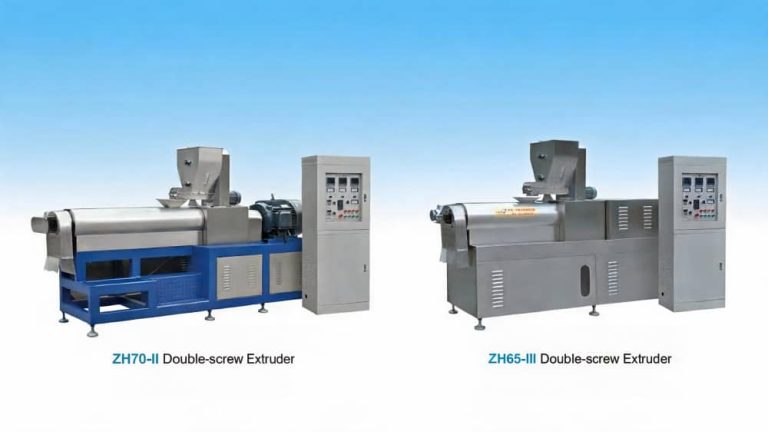
A1: Yes, absolutely. By precisely adjusting thermodynamic parameters (temperature profiles, moisture injection via the conditioning system, and screw RPM) alongside VFD controls, operators can seamlessly switch between floating fish feed and dense sinking shrimp pellets on the exact same processing line [1, 4, 6].
Q2: How long does Zhuoheng floating aqua feed maintain water stability?
A2: Thanks to the high starch gelatinization rate (85%–95%+) achieved by our co-rotating twin-screw geometry, our floating pellets maintain structural integrity in water for over 12 hours without disintegrating, achieving a certified buoyancy rate of ≥98% [1, 5, 10].
Q3: What raw ingredients are supported on Zhuoheng aqua feed extruders?
A3: Our positive-displacement twin screws handle a diverse matrix of ingredients, including corn flour, wheat bran, rice bran, soybean meal, fish meal, meat meal, and liquid fish oil up to 22% inclusion without material slipping or throughput loss [1, 3, 6].
Q4: Do you provide overseas installation, commissioning, and formula support?
A4: Yes. As part of our complete turnkey engineering delivery, Zhuoheng dispatches senior mechanical engineers to your overseas facility for site assembly, line commissioning, operator training, and custom CAD workshop layout planning [1, 4].