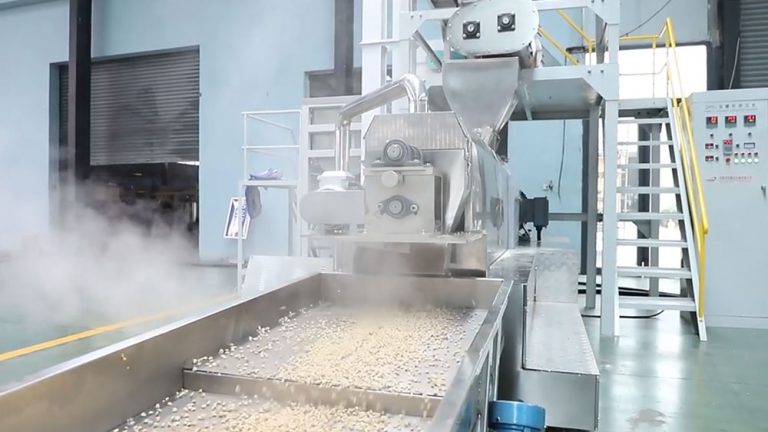
The Industry Shift to High Fresh Meat Inclusion in Premium Pet Food
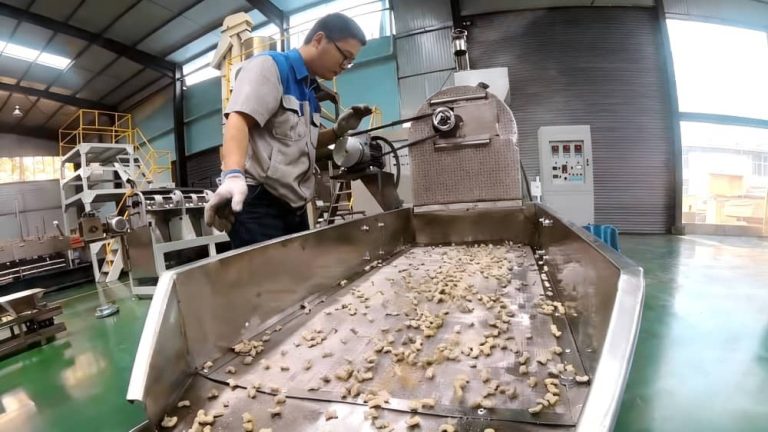
Driven by the global surge in human-grade and grain-free pet nutrition, modern pet food manufacturers are aggressively increasing fresh meat proportions in dog and cat kibble formulas. Today, market-leading brands demand fresh meat inclusion rates of 30%, 40%, or even 50%+ (calculated as liquid meat slurry before extrusion). However, injecting massive volumes of fresh meat slurry—which naturally contains 60%–70% water and high lipids—presents severe physical obstacles for traditional extrusion machinery, frequently causing barrel slipping, pressure loss, density inconsistency, and catastrophic motor stalling.
Key Takeaways / TL;DR
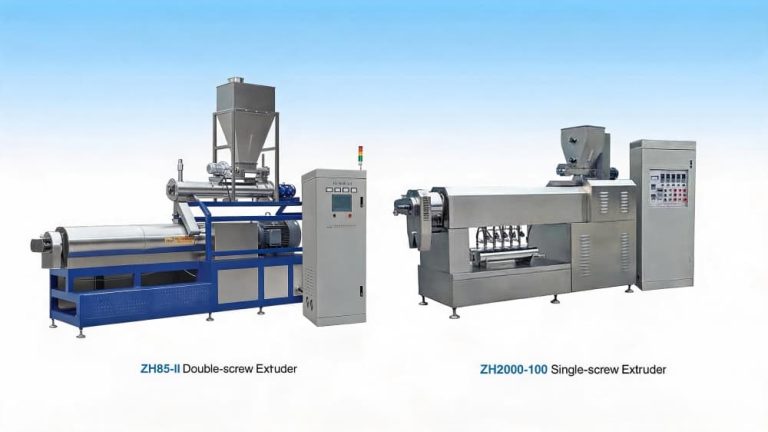
- No Screw Slipping: Co-rotating intermeshing twin screws provide positive displacement force, eliminating material slippage caused by high-fat and high-moisture meat slurry injections up to 45%+.
- Pre-Conditioning Mastery: A Biaxial Differential Pre-Conditioner (DDC) pre-gelatinizes dry starch and protein matrices at 85°C–95°C before meat slurry injection, ensuring structural kibble integrity.
- Metallurgical Defense: Premium 38CrMoAl nitrogen-treated alloy screws (HV850) withstand organic acids, micro-bone fragments, and high-fat corrosion for over 8,000 operational hours.
Rheological Obstacles: Moisture, Lipids, and Screw Slippage
When fresh meat slurry (ground bone-in chicken, beef, or salmon) is pumped directly into an extruder, it introduces two major lubricative agents into the barrel: free water and animal fats. In conventional single-screw or improperly configured twin-screw extruders, these lubricants create a fluid boundary layer between the material melt and the inner barrel wall.
This loss of friction causes the melt to spin passively with the screw rather than advancing forward. The mechanical consequences include:
- Loss of internal barrel pressure, resulting in unexpanded, soft, or crumbly kibble.
- Severe throughput fluctuations and surging at the die face.
- Uncooked starch matrices due to insufficient shear energy transfer.
The 2-Step Engineering Solution for High-Meat Extrusion
1. Thermal Pre-Gelatinization via Biaxial Differential Pre-Conditioner
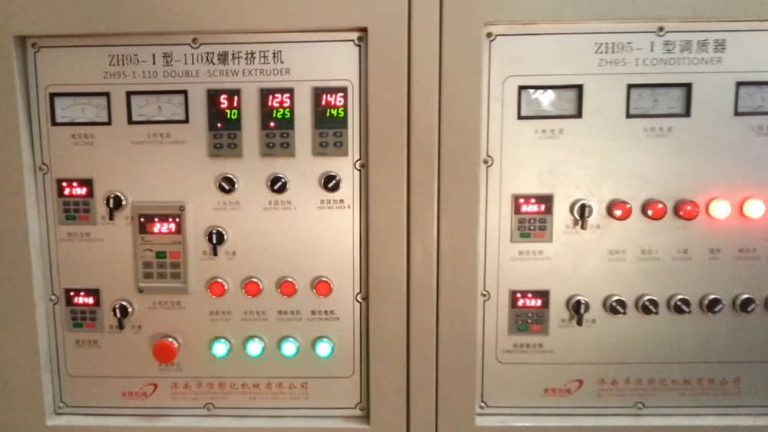
To successfully absorb 40%+ liquid meat slurry, the dry raw formulation (tapioca, peas, chickpeas, and dehydrated meal) must be thermally activated before meeting the wet slurry. Zhuoheng’s Biaxial Differential Pre-Conditioner utilizes two independent shafts rotating at differential speeds with adjustable paddles. Superheated steam and moisture are injected into the dry mix, elevating the core temperature to 85°C–95°C and pre-gelatinizing starches by 30%–50%. This pre-cooked matrix acts as a thermal sponge, rapidly absorbing the cold meat slurry without dropping barrel thermal energy.
2. Anti-Slippage Twin-Screw Element Architecture
Inside the extruder barrel, Zhuoheng engineers deploy a specialized 38CrMoAl co-rotating screw profile designed for high-hydrodynamic conveyance:
- Positive Displacement Conveying Elements: Self-wiping intermeshing geometries continuously scrape material off adjacent screws, physically forcing the slick meat melt forward regardless of fat lubrication.
- Targeted Shear & Mixing Blocks: Reverse-pitch elements and staggered kneading blocks create localized pressure barriers, forcing fat and moisture to emulsify thoroughly into the protein-starch matrix.
- Multi-Point Liquid Injection Ports: Meat slurry is metered into specific barrel zones after initial thermal cooking, preventing premature liquid cooling at the feed inlet.
Fresh Meat Inclusion Parameter Matrix
| Processing Parameter | Standard Kibble (5% – 15% Meat) | High-Meat Kibble (20% – 30% Meat) | Ultra High-Meat (35% – 45%+ Slurry) |
|---|---|---|---|
| Slurry Injection Location | Feed Inlet / Pre-Conditioner | Pre-Conditioner Barrel | Direct Barrel Injection (Zone 2/3) |
| Pre-Conditioner Temperature | 75°C – 85°C | 85°C – 92°C | 90°C – 98°C |
| In-Barrel Moisture Balance | 18% – 22% | 22% – 25% | 25% – 28%+ (Steam Vented) |
| Screw Shear Profile | Medium-High Shear | Medium Shear / High Torque | Low Shear / High Positive Displacement |
| Kibble Bulk Density | 380 – 420 g/L | 400 – 440 g/L | 420 – 460 g/L |
| Screw Alloy Grade | 38CrMoAl (HV800) | 38CrMoAl Gas Nitrided (HV850) | Bimetallic Alloy (HV950+) |
Metallurgical Defense Against Fresh Meat Acids & Micro-Bones
Fresh meat slurry contains natural organic acids and fine particulate bone fragments. Under continuous high-pressure conditions, lesser quality steel barrels quickly pit and scour. Zhuoheng manufactures all high-meat extrusion screws and barrel liners from 38CrMoAl premium alloy steel. Through advanced deep gas nitriding, the surface achieves a hardness of ≥HV850 with a nitrided layer depth of 0.5mm–0.8mm, providing exceptional resistance against acid corrosion and micro-abrasion for over 8,000 continuous operating hours.
Frequently Asked Questions (FAQ)
Q1: Can Zhuoheng twin-screw extruders process 40%+ fresh meat without motor stalling?
A1: Yes. Thanks to the positive displacement pumping action of our intermeshing co-rotating screws, high-torque gearbox distribution, and multi-zone liquid injection, Zhuoheng extruders easily handle up to 45%+ fresh meat slurry inclusion without material slippage or motor overload.
Q2: How do you prevent grain-free high-meat kibble from crumbling or breaking after drying?
A2: Kibble breakage is caused by ungelatinized starch and un-emulsified fat. Our Biaxial Differential Pre-Conditioner pre-cooks starch molecules to 85°C–95°C before meat injection, creating a strong viscoelastic matrix that binds fats and proteins tightly during final die shaping.
Q3: Is a slurry emulsifier machine required before pumping meat into the extruder?
A3: Yes. Fresh meat must be processed through a micro-cutter or colloid mill into a fine, pumpable emulsion (particle size < 1.0mm) before injection into the extruder barrel to ensure uniform density and prevent die plate blockages.
Q4: Do you offer overseas factory installation and recipe optimization for pet food producers?
A4: Yes. As part of our complete turnkey engineering services, Zhuoheng dispatches experienced engineers to your facility for equipment installation, PLC automation calibration, FAT validation, and local formula optimization for high-meat pet food lines.