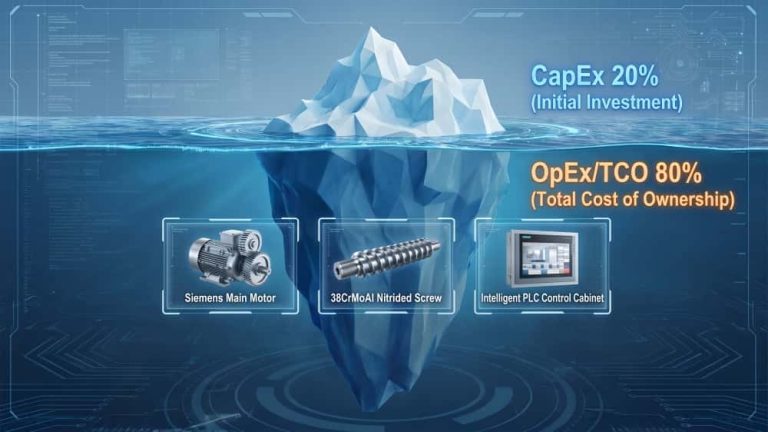
Extrusion Line Price Gaps: Purchase Price vs. Total Cost of Ownership (TCO)
When sourcing a food or feed extrusion line, have you ever received two quotes for the “same” target capacity that differ by 50% or more? In industrial machinery manufacturing, no supplier intentionally overprices just to lose a deal. A massive price gap on paper always reflects fundamental differences in engineering specifications, component metallurgy, drive-train torque margins, and your plant’s long-term Total Cost of Ownership (TCO).
Evaluating an extrusion system solely on its initial purchase price (CapEx) often hides substantial operational risks (OpEx). Before committing your capital, plant investors and procurement directors must evaluate critical engineering factors beyond the bottom-line quote.
Key Takeaways / TL;DR
- CapEx vs. OpEx Iceberg (20/80 Rule): Initial machine purchase accounts for only ~20% of a plant’s 5-year expenditure, while energy efficiency, maintenance, spare parts, and uptime represent the remaining ~80%.
- Continuous Rated Throughput: Engineering for 24/7 continuous rated output ensures stable yields, unlike smaller machines over-labeled with theoretical short-term peak capacities.
- Off-the-Shelf Local Serviceability: Standardizing on genuine Siemens motors and ABB/Delta VFDs allows local maintenance teams to source replacement parts within hours, eliminating weeks of overseas shipping downtime.
- Risk Mitigation via FAT & 2-Year Warranty: A mandatory 3-day full-line Factory Acceptance Test (FAT) with real raw materials paired with a 2-Year Warranty Upon Receipt protects your production ramp-up period.
Continuous Rated Throughput vs. Theoretical Peak Capacity
A primary driver of the 50%+ price difference lies in how manufacturers define production capacity. Budget-oriented proposals frequently utilize a smaller extruder frame and label it with a short-term, theoretical “peak” output figure under ideal laboratory conditions.
However, during continuous 24/7 industrial factory operations, a smaller extruder running at maximum limits suffers from severe gearbox torque fatigue, insufficient screw length-to-diameter (L/D) ratios, and inadequate thermal drying capacity. This results in pressure surging, uneven kibbles, and frequent drive overload trips.
At Zhuoheng Machinery, every extrusion line is engineered for true 24/7 continuous rated output. To verify continuous performance prior to shipment, we enforce a mandatory 3-day full-line Factory Acceptance Test (FAT) using real raw materials, ensuring your plant achieves stable, high-yield production from day one.
Wear Metallurgy & Global Component Off-the-Shelf Availability
Equipment reliability and maintenance costs depend directly on material science and electrical subsystem choices. Why do professional machinery manufacturers standardize on premium nitrided 38CrMoAl alloy wear parts and globally recognized electrical components like Siemens, ABB, and Delta?
Minimizing Mean Time to Repair (MTTR)
Standardizing on tier-one international brands is not merely about initial build quality; it is a critical strategy for local off-the-shelf component availability. If a specialized unbranded electrical relay or inverter fails years down the line, sourcing a custom replacement from an overseas supplier can cause weeks of unplanned factory downtime while waiting for international shipping and customs clearance.
By integrating globally accessible Siemens motors and ABB/Delta VFDs, your local plant maintenance team can procure identical replacement parts off-the-shelf locally within hours, minimizing Mean Time to Repair (MTTR) and keeping your line running.
High-Torque Wear Metallurgy
Extruding abrasive grains, high-ash meal, or acidic starches causes severe friction along screws and barrel liners. Zhuoheng fabricates screw elements from 38CrMoAl alloy steel with deep plasma nitriding (yielding surface hardness ≥HV850 and case depth 0.5–0.8mm). This extends wear life beyond 8,000 continuous operating hours, preserving Specific Mechanical Energy (SME) transfer and product expansion consistency.
Factory Acceptance Testing (FAT) & 2-Year Warranty Upon Receipt
When reviewing machinery proposals, plant managers must read the warranty start-date conditions carefully. Low upfront quotes often come with restricted 1-year warranties that begin on the Bill of Lading (B/L) date. Because international sea freight, customs clearance, and civil installation routinely consume 2 to 3 months, a buyer’s actual operational coverage is severely reduced.
2-Year Warranty Effective From Date of Receipt
Professional manufacturers back their heavy-duty build quality with transparent terms. Zhuoheng backs its turnkey extrusion systems with a signature 2-Year Warranty Effective From the Date of Receipt at your factory port or site. This absorbs transit time risks and provides full engineering coverage throughout your plant’s critical installation, commissioning, and capacity ramp-up phase.
Financial Analysis: CapEx vs. OpEx in 5-Year Plant Operations
The comparative matrix below illustrates the financial and operational differences between conventional budget-oriented machinery proposals and Zhuoheng industrial-grade turnkey systems over a 5-year lifecycle:
“Transitioning to a heavy-duty twin-screw line with Siemens electrics and a 2-year warranty eliminated our frequent unscheduled downtime. The CapEx savings from a budget supplier would have been wiped out by just two weeks of lost production.” — Piotr K., Plant Manager (Poland)
Frequently Asked Questions (FAQ)
Q1: Why do two suppliers quote 50% different prices for the “same” 1 Ton/Hour capacity?
A1: Price gaps stem from machine sizing, motor power margins, gearbox torque density, and component grades. Budget suppliers often quote smaller frame extruders that achieve 1 t/h only during short theoretical peaks, whereas industrial suppliers quote heavy-duty systems built to sustain 1 t/h continuously 24/7 with Siemens motors, heavy gearboxes, and multi-layer dryers.
Q2: How do Siemens motors and ABB/Delta VFDs reduce long-term operational costs?
A2: Variable Frequency Drives (VFDs) regulate motor speeds according to real-time dough viscosity, saving up to 15%–20% in electrical energy compared to direct-on-line drives. Furthermore, using global brand standards ensures off-the-shelf spare part availability in almost any industrial city, preventing weeks of downtime waiting for overseas shipping.
Q3: What is the financial benefit of a 2-Year Warranty Effective From Date of Receipt?
A3: Standard 1-year warranties start on the shipping (B/L) date, meaning 2 to 3 months of coverage are lost during ocean transit and customs clearance. Zhuoheng’s 2-Year Warranty Upon Receipt guarantees full 24-month protection starting when the machinery arrives at your plant, covering your entire installation, commissioning, and production ramp-up period.
Q4: How does a 3-day full-line Factory Acceptance Test (FAT) prevent post-shipment losses?
A4: A dry test (running motors without material) cannot reveal how dough behaves under high pressure and temperature. Running a mandatory 3-day trial using real raw materials ensures screw shearing, thermal pre-conditioning, cutter speed, and dryer airflow are calibrated prior to crating, eliminating costly on-site modifications.
Engineering Consultation & Customized TCO Assessment
Planning a new food or feed extrusion line investment? Contact Jinan Zhuoheng Extrusion Machinery today to request a comprehensive CapEx/OpEx financial breakdown, 3D factory layout blueprint, and equipment proposal tailored to your target recipe.
Related solutions: Industrial Twin & Single Screw Food Extruders | Service & Lifecycle Support (2-Year Warranty)
Further reading: Chinese Twin-Screw Extruders vs. European Brands: Performance, Metallurgy & Cost Comparison