Turnkey Pet Food Plant Engineering: Financial & Infrastructure Planning
Establishing a modern 1.0 to 3.0 Ton/Hour commercial pet food (dog and cat kibble) manufacturing facility is a capital-intensive decision that requires precise coordination between machinery acquisition (CAPEX), building architecture, and heavy utility allocation. Investor groups, CFOs, and plant directors evaluating new pet food ventures must look beyond the initial extruder price tag. Long-term operational profitability depends heavily on matching machine throughput with adequate site utility infrastructure—specifically electrical transformer ratings (kVA), saturated steam boiler output (t/h), compressed air volumetric flow, and vertical ceiling clearances.
Inadequate pre-project planning often leads to costly post-installation utility retrofits, electrical brownouts during peak motor loads, or insufficient steam conditioning. Poor steam conditioning directly suppresses starch gelatinization (<85%) and fresh meat slurry assimilation, leading to erratic kibble density, high fines generation, and unappealing product palatability. Based on field installation data across global commercial pet food facilities utilizing Zhuoheng heavy-duty twin-screw extrusion platforms (including the ZH95-I and ZH115 systems), this engineering guide outlines the exact utility quotas, plant layout requirements, and 5-year Total Cost of Ownership (TCO) models necessary for investment board approval.
Key Takeaways / TL;DR
- Utility Infrastructure Thresholds: A 1.0–3.0 t/h commercial kibble line requires a dedicated 3-phase electrical transformer rated at 500 kVA to 800 kVA, alongside a saturated steam boiler supplying 1.0 to 2.0 Tons/Hour at 0.6–0.8 MPa.
- Vertical Architectural Clearance: Installing heavy-duty double-shaft differential pre-conditioners above the extruder feed throat demands a minimum factory ceiling height of 6.5 to 8.0 meters.
- Recipe Flexibility & Fresh Meat Handling: Co-rotating nitrided twin screws combined with pre-conditioning allow continuous processing of up to 20%–40% fresh meat slurry without screw slippage or barrel surging.
- CAPEX ROI拐点: Direct source-factory procurement from Zhuoheng eliminates middleman markups, optimizing equipment CAPEX by 40%–50% while integrating tier-one global components (Siemens main motors, Schneider electrics, Delta VFDs).
Factory Footprint & Civil Engineering Spatial Allocation
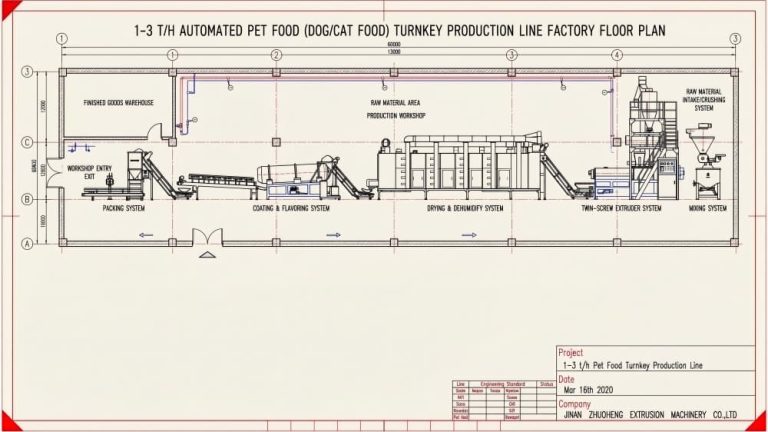
Designing a streamlined, sanitary, and expandable pet food factory layout requires separating raw material receipt, dry ingredient grinding, extrusion processing, thermal drying, liquid fat coating, and automated packaging into distinct hygienic zones.
Floor Space & Ceiling Height Requirements
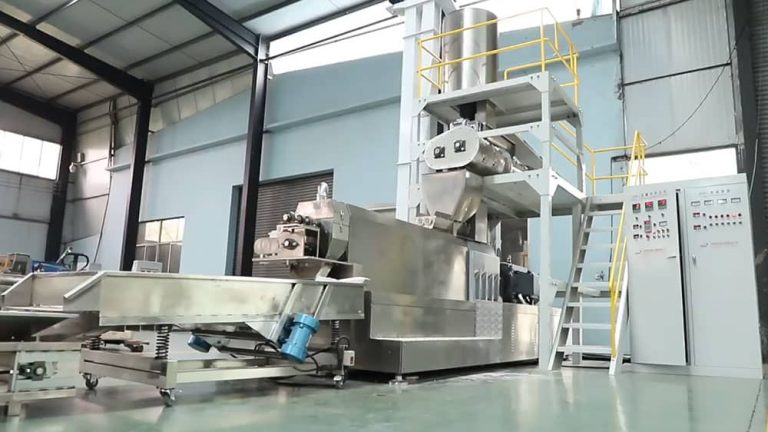
For a standard 1.0 to 3.0 t/h automated line, the processing equipment array spans approximately 35 to 50 meters in length and 6 to 8 meters in width. Including raw material staging, intermediate buffer hoppers, maintenance access corridors, and finished bag warehousing, the recommended total facility footprint ranges from 600 m² to 1,200 m².
Vertical clearance is a critical architectural factor. Because high-capacity lines elevate the double-shaft differential pre-conditioner and storage silos on a structural steel mezzanine platform directly above the twin-screw extruder inlet, the facility must provide a clear hook height of at least 6.5 to 8.0 meters to accommodate gravity-fed material downspouts and crane-assisted screw maintenance.
Energy & Utility Quotas: Transformer, Boiler & Compressed Air
Continuous 24/7 extrusion processing demands uninterrupted utility supply lines engineered with a 20% safety margin to handle peak starting torques and transient pressure drops.
Electrical Power Distribution (kVA)
Total installed electrical power for a complete 1.0–3.0 t/h pet food line—encompassing micro-pulverizers, pre-conditioners, main drive motors, multi-layer circulation dryers, oil sprayers, and packaging units—ranges from 330 kW to 500+ kW. Operating at a power factor (cos φ) of approximately 0.88 with variable frequency soft-starts, the plant requires a dedicated step-down transformer rated between 500 kVA and 800 kVA.
Saturated Steam Supply
Steam serves a dual purpose in premium kibble production: thermal conditioning of raw meals and high-efficiency thermal drying. Direct steam injection into the double-shaft conditioner heats the meal to 85°C–95°C, initiating starch pre-gelatinization and lowering mechanical barrel wear. Simultaneously, steam heat exchangers power the multi-layer circulation belt oven. The facility must install a saturated steam boiler producing 1.0 to 2.0 Tons/Hour at a regulated header pressure of 0.6 to 0.8 MPa (6–8 bar).
Dry Compressed Air
Pneumatic diverter valves, air-assisted liquid coating spray nozzles, cutter head positioning, and automatic bag-clamping packaging scales require centralized compressed air. A screw compressor supplying 2.0 to 3.5 m³/min of dry, oil-free compressed air at 0.6–0.8 MPa is mandatory to ensure reliable actuator performance.
End-to-End Processing Architecture: From Grinding to Packaging
Zhuoheng engineers full turnkey pet food lines organized into seven synchronized operational modules:
- Raw Material Pulverization: High-speed hammer mills or air-classifier pulverizers grind protein meals and grains to 60–80 mesh (≤250μm) for uniform dough hydration.
- Precision Batching & Homogeneous Mixing: Micro-dosing scales and ribbon blenders achieve a mixing uniformity coefficient (≥98% CV).
- Biaxial Differential Pre-Conditioning: Steam and fresh meat slurry are aggressively blended with dry flours, increasing residence time to achieve deep thermal maturation.
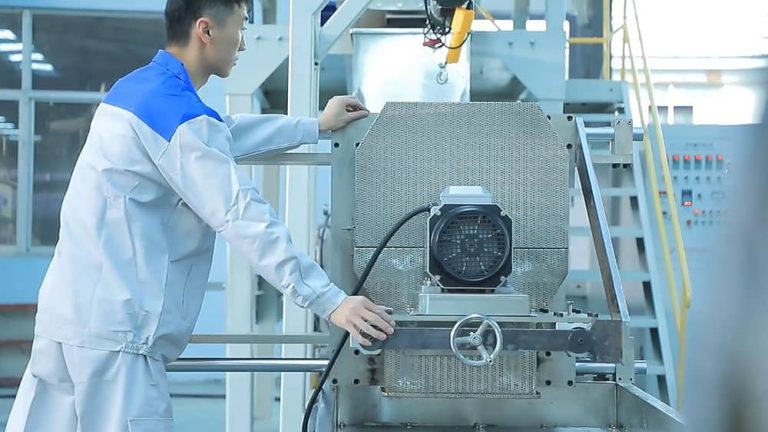
- Twin-Screw Extrusion & Face Cutting: Co-rotating 38CrMoAl nitrided screws deliver positive displacement conveying and controlled Specific Mechanical Energy (SME) to expand kibbles through customized die plates.
- Thermodynamic Multi-Layer Drying: Continuous stainless steel belt ovens reduce kibble moisture from ~22% down below 10% uniformly.
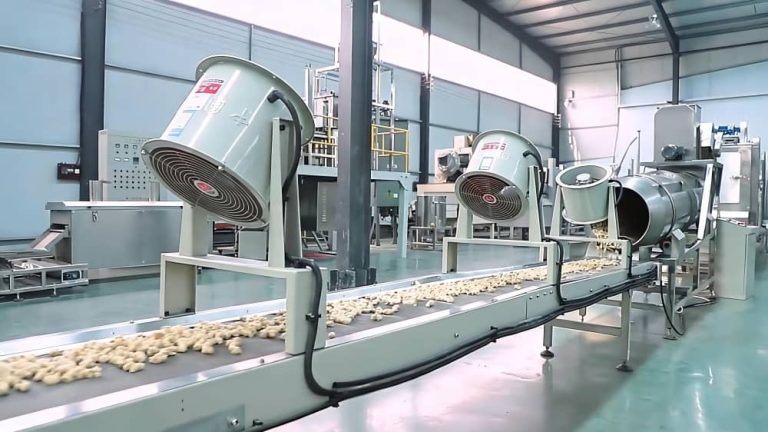
- Dual-Drum / Vacuum Liquid Coating: Precise spray atomization applies liquid animal fats, digest palatants, and essential oils across every kibbles’ porous matrix.
- Counter-Flow Cooling & Automated Packaging: Convective cooling lowers kibble temperature to ambient before electronic quantitative weighing and bag sealing.
CAPEX Breakdown & Utility Allocation Matrix
The table below summarizes the core utility specifications, machinery power ratings, and facility footprint requirements across Zhuoheng’s commercial pet food line configurations:
“Transitioning to Zhuoheng’s 1.2 ton/hour twin-screw pet food line allowed us to double our fresh meat inclusion rate to 35% while maintaining flawless kibble expansion. The pre-installation CAD layout engineering saved us weeks of utility fitting.” — Piotr K., Plant Manager (Poland)
5-Year Total Cost of Ownership (TCO) Financial Model
When calculating return on investment (ROI) for commercial pet food lines, investors should evaluate the complete 5-year TCO equation:
TCO = Equipment CAPEX + Electrical Energy OPEX + Steam Fuel Costs + Wear Component Maintenance + Unplanned Downtime Risk
- CAPEX Acquisition Advantage: Sourcing directly from Zhuoheng’s ISO 9001 certified manufacturing plant eliminates broker markups, reducing total machinery investment by 40%–50% compared to Western European OEMs while retaining identical core component quality (Siemens motors, Delta/ABB VFDs, Schneider electrics).
- Energy Efficiency via VFD Regulation: Integrated variable frequency drives on feeders, main extruders, and cutter heads optimize energy draw based on real-time dough torque, saving up to 15%–20% in active electrical power draw during partial-load runs.
- Wear Part Longevity: Screws and barrel liners constructed from 38CrMoAl alloy steel with deep nitriding treatment (depth 0.5–0.8mm, hardness ≥HV850) resist abrasive ash and bone meal wear, delivering over 8,000 operational hours before replacement. Optional bimetallic tungsten carbide coatings further extend screw life under high-ash formulations.
Frequently Asked Questions (FAQ)
Q1: What transformer capacity is recommended for a 1.5 Ton/Hour pet food plant?
A1: For a 1.5 t/h plant based on the Zhuoheng ZH95-I or ZH115 platform (~330 kW to 400 kW total installed power across grinders, extruders, dryers, coaters, and packaging), we recommend installing a dedicated 500 kVA or 630 kVA transformer to ensure adequate power factor margin and headroom for future expansion.
Q2: Can the same Zhuoheng line process both dry dog kibble and cat food?
A2: Yes. By adjusting recipe formulations, barrel temperature profiles, VFD screw speeds, and substituting die plates (ranging from 1mm micro-pellets for cats up to 15mm bone-shaped kibbles for dogs), the same line handles a full range of pet foods seamlessly.
Q3: How does pre-conditioning affect fresh meat handling in pet food formulas?
A3: High-temperature steam conditioning in Zhuoheng’s double-shaft differential pre-conditioner pre-cooks dry starches before adding liquid meat slurry. This maintains high Specific Mechanical Energy (SME) inside the barrel, preventing hydro-lubrication slippage and ensuring complete starch gelatinization (≥90%).
Q4: What turnkey engineering services does Zhuoheng provide prior to shipping?
A4: Zhuoheng provides end-to-end project support, including customized 2D/3D plant layout CAD drawings, utility interface schematics, pre-shipment factory acceptance testing (FAT), and on-site overseas commissioning by senior technical engineers.
Technical Consultation & Turnkey Project Design
Planning to build a new commercial pet food plant or upgrade your existing extrusion facility? Contact Jinan Zhuoheng Extrusion Machinery to request a customized CAPEX/OPEX model, 3D workshop layout, and technical equipment quote within 24 hours.
Related solutions: Turnkey Pet Food Extrusion Line | Multi-Layer Continuous Drying & Roasting Ovens
Further reading: 1 Ton/Hour Pet Food Plant Setup: CAPEX, Utility & Layout