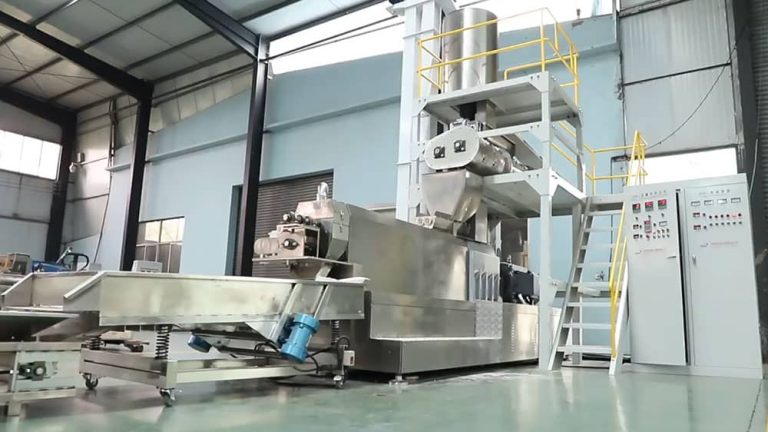
The Thermodynamics of Thermal Pre-Conditioning in Feed Extrusion
In high-capacity aquatic feed and pet food extrusion, achieving complete starch gelatinization and protein denaturation is essential for pellet structural integrity, water stability, and animal digestibility. Historically, process engineers relied on the main extruder barrel to perform both thermal cooking and mechanical shaping. However, converting electrical power into mechanical friction (Specific Mechanical Energy, or SME) inside the barrel is thermally inefficient and subjects expensive 38CrMoAl screw elements to accelerated mechanical wear.
Modern continuous extrusion architectures solve this by transferring up to 50% of the total thermal cooking workload to an upstream Biaxial Differential Conditioner. By injecting low-cost utility steam and water into a dual-shaft chamber with differential rotational speeds, raw mash is pre-cooked before entering the screw flights—raising starch pre-gelatinization rates above 85% while reducing main motor power consumption by 12% to 15%.
Key Takeaways / TL;DR
- Extended Residence Time: Biaxial differential conditioners utilize dual independent shafts with varying paddle pitch angles to increase material residence time to 90 – 180 seconds (compared to 20 – 30 seconds in legacy single-shaft units).
- High Pre-Gelatinization Rate: Pre-cooking raw mash with saturated steam at 85°C–95°C elevates starch pre-gelatinization to >85% prior to barrel entry, boosting aquatic pellet water stability (>12 hours).
- Main Drive Power Reduction: Supplying pre-hydrated, pre-gelatinized dough lowers internal barrel viscosity, reducing main motor torque requirements and yielding a 15% net reduction in main drive kWh/ton energy consumption.
1. Micro-Physics & Fluid Dynamics: Differential Dual-Shaft Motion
The mechanical limitation of a conventional single-shaft preconditioner is its single rotational velocity profile. Particles near the outer wall travel faster than those near the shaft center, resulting in short-circuiting where dry raw meal exits into the extruder without absorbing sufficient steam.
Zhuoheng’s Biaxial Differential Conditioner operates on a fluid-mechanically superior dual-shaft principle:
- Differential Speed Ratio (2:1 or 3:1): Two parallel shafts rotate in opposite directions at different speeds (e.g., fast shaft at 300 RPM, slow shaft at 150 RPM). This speed differential creates high-shear fluid velocity gradients that continuously break up agglomerates.
- Intermeshing Paddle Geometry: As paddles cross each other’s rotational envelope, dough particles are transferred fluidly between shafts in a figure-eight turbulence pattern. This guarantees 100% steam contact and uniform moisture penetration into every starch granule.
- Plug-Flow Residence Time: Adjustable paddle pitch angles allow operators to retard axial forward motion, retaining the material inside the steam chamber for up to 3 minutes to achieve deep thermal hydration.
2. Benchmark Comparison: Single-Shaft vs. Zhuoheng Biaxial Conditioner
The following technical parameter matrix highlights the mechanical, thermal, and economic advantages of upgrading from a single-shaft unit to a Zhuoheng Biaxial Differential Conditioning System on a 1.0 to 1.2 Ton/Hour extrusion platform.
| Conditioning Engineering Metric | Legacy Single-Shaft Preconditioner | Zhuoheng Biaxial Differential Conditioner |
|---|---|---|
| Shaft & Drive Architecture | Single Central Shaft (Fixed RPM) | Dual Independent Differential Shafts |
| Average Residence Time | 15 – 30 Seconds | 90 – 180 Seconds (Adjustable) |
| Mash Temperature at Discharge | 60°C – 75°C | 85°C – 95°C (Steam Saturated) |
| Starch Pre-Gelatinization Rate | 45% – 60% (Incomplete) | ≥ 85% – 90% (Deep Gelatinization) |
| Moisture Addition Capability | Up to 18% Total Moisture | 22% – 28% Homogeneous Hydration |
| Main Extruder Motor Load | High Mechanical Load (High Friction) | 15% Reduced Motor Torque / Power Draw |
| Finished Feed Water Stability | 4 – 6 Hours | 12 – 24 Hours (Floating & Shrimp Feeds) |
3. Financial Mechanics: Why Thermal Steam is Cheaper Than Electric Friction
From an operational cost (OPEX) standpoint, generating thermal energy in an industrial boiler utilizing natural gas, diesel, or biomass costs significantly less per enthalpy unit than converting electricity into mechanical friction via an electric motor.
When raw mash enters the extruder barrel cold, the twin screws must apply severe mechanical shear to generate friction heat, consuming high amounts of kilowatt-hours (kWh). By contrast, raising mash temperature to 90°C inside the Biaxial Conditioner using plant utility steam provides the following measurable economic gains:
- Specific Energy Shift: Pre-conditioning shifts the energy profile from expensive Specific Mechanical Energy ($SME$) to cost-effective Specific Thermal Energy ($STE$).
- Reduced Screw Wear: Supplying pre-softened, fully hydrated dough reduces abrasive friction between the 38CrMoAl screw flights and the barrel liner wall, extending screw service life by 30% to 40%.
- Increased Line Capacity: Because the extruder barrel no longer spends length (L/D ratio) heating up cold meal, the full barrel length is utilized for high-pressure cooking and shaping, increasing overall line throughput ($kg/h$) by up to 20%.
Frequently Asked Questions (FAQ)
1. Why is a biaxial differential conditioner critical for aquatic feed production?
Aquatic species (such as shrimp and carnivorous fish) require high dietary protein and highly digestible gelatinized starches to ensure pellet water stability (>12 hours) and prevent water pollution. A biaxial conditioner achieves >85% pre-gelatinization, ensuring pellets do not disintegrate prematurely in water.
2. Can I add fresh liquid ingredients or oils inside the biaxial conditioner?
Yes. Zhuoheng biaxial conditioners feature multi-point liquid injection manifolds. Operators can meter water, steam, liquid lecithin, fish solubles, and water-soluble vitamins directly into the mixing zone during conditioning.
3. Is a biaxial differential conditioner hard to clean between batch changes?
No. Zhuoheng preconditioners are constructed entirely from food-grade SUS304 stainless steel with large, quick-opening inspection doors along the chamber length. The self-wiping intermeshing paddle design minimizes internal dough residue, making sanitization rapid and straight-forward.
Upgrade Your Processing Line with Advanced Pre-Conditioning Technology
Maximize thermal efficiency, cut electricity bills by 15%, and produce premium aquatic and pet feeds with superior water stability. Zhuoheng’s biaxial differential preconditioners can be retrofitted onto existing extrusion systems or supplied as part of our turnkey double-screw production lines. Contact our application engineers today to request CAD dimensional drawings, steam consumption calculations, and a factory-direct quotation.