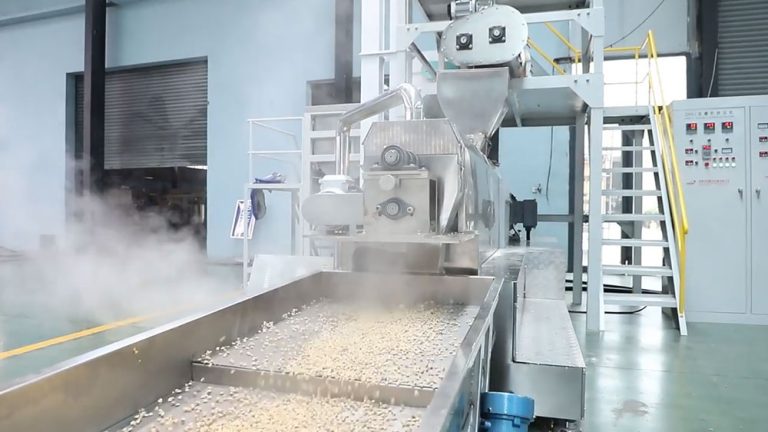
Engineering & Investment Planning for a 1 Ton/Hour Pet Food Facility
For investors, agricultural conglomerates, and expanding pet food manufacturers, establishing a modern 1 ton/hour (1,000 kg/h) dry pet food processing facility represents the optimal balance between initial capital expenditure (CAPEX) and long-term operational efficiency (OPEX). However, transition from a business concept to an operational plant requires precise engineering calculations: factory floor area (m²), utility infrastructure (electricity, steam, compressed air), dry-to-wet ingredient mass balances, and equipment selection.
Key Takeaways / TL;DR
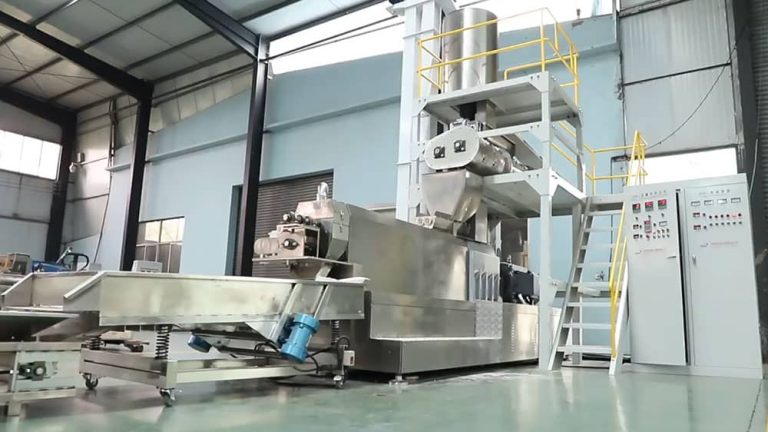
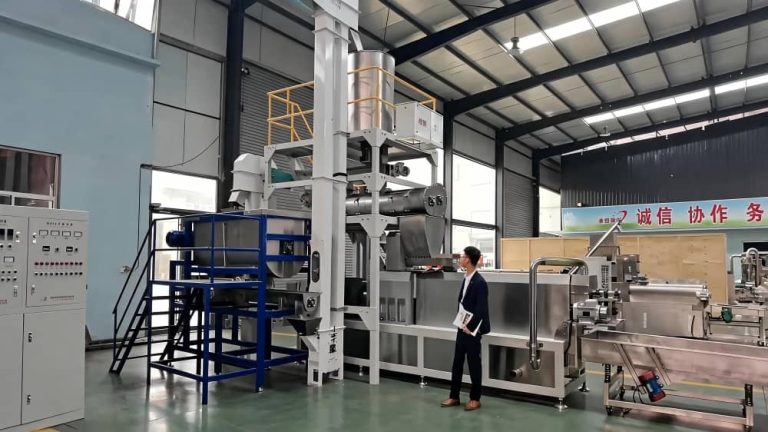
- Optimal Footprint: A standard 1 ton/hour automated turnkey line requires approximately 450 m² to 600 m² of factory floor space, with a minimum clear height of 6.0 meters for gravity-assisted vertical processing.
- Utility Infrastructure Requirements: Total connected power capacity requires 180 kW – 240 kW, alongside an industrial steam supply of 400 – 600 kg/h at 0.6–0.8 MPa pressure for pre-conditioning and multi-layer drying.
- High ROI & Turnkey Efficiency: Compared to European equivalents, sourcing a fully automated twin-screw processing line from Zhuoheng reduces machinery CAPEX by 50%–65% while maintaining Siemens PLC automation, 38CrMoAl alloy wear standards, and CE compliance.
Turnkey Equipment Configuration & Process Flow
A complete 1,000 kg/h pet food manufacturing line operates through five continuous, automated processing modules designed to eliminate manual contamination and ensure precise nutritional mixing:
- Raw Material Dosing & Micro-Pulverization Module: High-speed vertical mixers coupled with a pulse-jet dust collector and pulverizer to ensure raw ingredient particle size reaches 60–80 mesh (≤250μm).
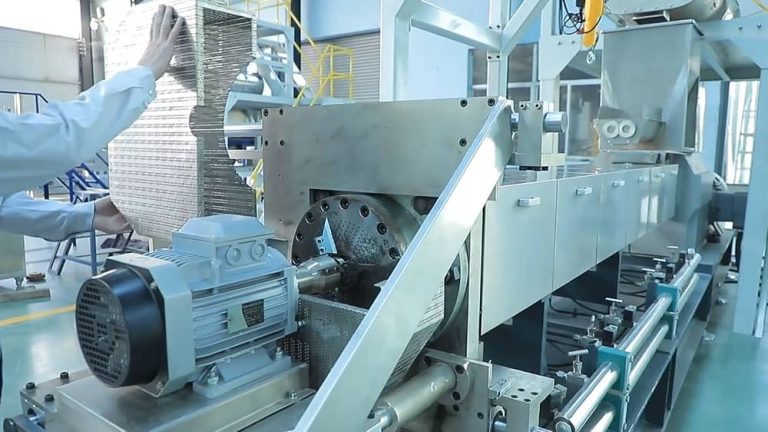
- Biaxial Differential Conditioning & Twin-Screw Extrusion Module: Steam conditioning at 85°C–95°C followed by a high-torque Zhuoheng ZH70-II or ZH85-II Co-Rotating Twin-Screw Extruder with multi-point liquid/fresh meat injection.
- Continuous Multi-Pass Belt Drying Module: Gas, diesel, or steam-heated multi-layer circulating dryer reducing kibble moisture from 22%–26% down to a shelf-stable ≤8.5%.
- Vacuum Coating & Oil/Flavoring Module: Twin-drum seasoning system for precise external application of animal fats, digest liquids, and palatability enhancers.
- Counter-Flow Cooling & Automated Bagging Module: Pellets are cooled to within +5°C of ambient temperature before transferring to a vertical form-fill-seal (VFFS) or 10–25kg quantitative bagging scale.
1 Ton/Hour Turnkey Utility & Facility Specification Matrix
| Facility Specification Parameter | 1000 kg/h Standard Line Specification | Engineering Note & Allocation Guide |
|---|---|---|
| Factory Floor Footprint (L × W × H) | 35m × 12m × 6.0m (420 m²) | Excludes raw ingredient warehouse and finished goods storage area. |
| Total Installed Power Capacity | 210 kW – 250 kW | Includes extruder main motor (75kW/90kW), dryer, pulverizer, and auxiliaries. |
| Boiler Steam Consumption | 400 – 600 kg/h @ 0.8 MPa | Required for Biaxial Pre-Conditioner (100°C) and steam belt drying. |
| Compressed Air Requirement | 1.2 m³/min @ 0.6 – 0.8 MPa | Powers pneumatic diverter valves, cutter head positioning, and bagger. |
| Operational Labor Crew | 2 – 3 Technicians per shift | Centralized Siemens PLC touch-screen automation controls the entire line. |
| Average Electricity Consumption | 110 – 140 kWh per ton produced | Optimized via Delta / ABB Variable Frequency Drives (VFD) on all motors. |
CAPEX Allocation: Machinery, Civil Engineering, and Utilities
When budgeting for a 1 ton/hour pet food venture, investors must divide total capital expenditure across four primary cost centers:
- Primary Processing Equipment (45% – 55% CAPEX): Sourcing the core extrusion line, dryers, coaters, and automated packaging machinery. Sourcing from Zhuoheng yields substantial CAPEX savings without sacrificing metallurgy or automation grade.
- Utility Infrastructure (15% – 20% CAPEX): Installing a steam boiler system (gas or biomass), air compressor, water softeners, and electrical transformer substation.
- Civil Works & Dust/Hygiene Control (15% – 20% CAPEX): Epoxy floor coatings, micro-particle dust extraction systems, and cleanroom partitioning for post-dryer packaging areas.
- Commissioning, Molds & Freight (5% – 10% CAPEX): Shipping containers, custom kibble shape dies, spare parts kit (screws/barrel liners), and engineer site commissioning fees.
Frequently Asked Questions (FAQ)
Q1: What is the total machinery budget for a turnkey 1 ton/hour pet food processing line from Zhuoheng?
A1: A complete automated 1 ton/hour turnkey line (including pulverization, twin-screw extrusion, multi-layer drying, vacuum coating, cooling, and automated packaging) typically ranges between $85,000 and $160,000 USD depending on automation levels, stainless steel grades (SUS304/316), and heat source configuration.
Q2: Can a 1 ton/hour pet food line also produce aquatic feed or cat food?
A2: Yes. The Zhuoheng ZH70-II / ZH85-II twin-screw extrusion system is multi-functional. By adjusting the screw configuration, die plates, and operating temperatures, the same processing line can switch between dog kibble, cat food, floating fish feed, and sinking aquafeed.
Q3: How much factory area is needed for the entire pet food manufacturing facility?
A3: While the machinery line occupies approximately 420 m² (35m × 12m), we recommend a total facility footprint of 1,000 m² to 1,500 m² to accommodate raw ingredient storage, finished product warehousing, testing laboratory, and office space.
Q4: Do you assist overseas buyers with plant layout design and utility planning?
A4: Yes. Upon project deposit, Zhuoheng’s engineering department generates customized 2D and 3D CAD factory layout blueprints showing exact positions for foundations, electrical connections, steam piping, and drainage channels.