The Hidden Operational Cost of Mechanical Degradation in Feed Extrusion
In high-throughput aqua feed mills, pet food plants, and industrial starch facilities, processing abrasive formulations containing high-ash meat and bone meal, mineral premixes, or high-fiber bran subjects twin-screw extruders to relentless mechanical abrasion. Over thousands of operational hours, the precision clearance between the rotating screw flight apex and the inner barrel wall gradually expands.
When this critical clearance dilates beyond design tolerances, material backflow (slippage) occurs inside the barrel. This loss of positive displacement leads to a severe drop in extrusion die backpressure, incomplete starch gelatinization (<80%), unstable pellet buoyancy, and a 15% to 25% surge in main drive energy consumption. To protect Overall Equipment Effectiveness (OEE) and prevent sudden barrel seizure, plant maintenance engineers must implement a proactive screw-to-barrel clearance measurement SOP and specify the correct wear-resistant metallurgy.
Key Takeaways / TL;DR
- Clearance Dilation Threshold: When screw-to-barrel radial clearance exceeds 1.5 mm to 2.0 mm (or thread flight thickness wears by >0.3 mm), pumping efficiency drops catastrophically, requiring immediate liner or screw element replacement.
- Graded Metallurgy Selection: While standard 38CrMoAl plasma-nitrided steel (HV850 / HRC 65+) provides cost-effective 6,000-hour service life for cereal snacks, high-ash feed mills should upgrade to Bimetallic tungsten/nickel-alloy bushings (12,000+ hours) or HIP powder metallurgy liners (18,000+ hours).
- Predictive Maintenance SOP: Measuring clearance at 3-to-6-month intervals during planned holiday downtimes prevents emergency shut-offs and reduces 5-year replacement CAPEX by replacing only damaged high-shear discharge elements.
1. Graded Metallurgy Matrix: 38CrMoAl vs. Bimetallic vs. HIP Powder Metallurgy
The rate of mechanical degradation depends directly on ingredient abrasiveness. Raw materials rank in wear severity as follows: High Ash / Bone Meal > High Crude Fiber > High Protein Isolates > Native Starches > High Fat. To optimize the Total Cost of Ownership (TCO), Zhuoheng provides three tiers of metallurgy engineered for distinct operating environments:
| Metallurgy Grade | Material & Treatment | Surface Hardness | Nominal Wear Life (High-Ash Feed) | Recommended Application Scenario |
|---|---|---|---|---|
| Tier 1: Standard Grade | 38CrMoAl Alloy Steel + Deep Gas Nitriding (0.5–0.8mm depth) | ≥ HV850 – 1100 (HRC 62 – 65) |
4,000 – 6,000 Hours | Puffed corn snacks, breakfast cereals, food-grade starches, low-ash pet kibbles. |
| Tier 2: Premium Bimetallic | Tool Steel Body + Clad Cr12MoV / Nickel-Tungsten Carbide Liner | ≥ HRC 65 – 68 | 10,000 – 12,000 Hours | Commercial pet food (>15% bone meal), sinking/floating aqua feeds, HMMA meat analogs. |
| Tier 3: Ultra HIP Metallurgy | Hot Isostatic Pressing (HIP) Solid Sintered Powder Alloy Bushings | ≥ HRC 68 – 72 | 18,000 – 25,000 Hours | Corrosive acidic API drilling starches, 24/7 mega feed mills, high-ash industrial waste. |
2. Standard Operating Procedure (SOP): Screw & Barrel Clearance Inspection
To accurately determine when to replace twin screw extruder barrel liners, maintenance teams should execute this standardized 4-step inspection protocol during scheduled shutdowns:
Step 1: Controlled System Purging & Thermal Cooldown
Purge the extruder barrel with a coarse cornmeal and water mix to flush out all sticky formulations. Allow the heating zones to cool naturally to below 40°C before disassembly. Never force-cool barrels with cold water, as thermal shock can warp high-precision alloy sleeves.
Step 2: Hydraulic Shaft Pulling & Visual Surface Check
Disconnect the die head and utilize the hydraulic screw puller to extract the splined screw assemblies. Inspect the flights visually for micro-pitting, cracking, or discoloration. Examine the inner barrel liners using a bore light to detect axial scoring or deep grooving.
Step 3: Precision Caliper & Feeler Gauge Measurement
- Screw Flight OD: Measure the outer diameter of screw flights at 5 points along the shaft (Focusing on the high-shear discharge zone near the die) using a calibrated digital micrometer.
- Barrel ID & Radial Gap: Measure the inner diameter of the barrel sleeve using a three-point internal micrometer. Re-insert the screw shaft and measure the clearance gap using precision feeler gauges inserted between the screw flight crest and the liner wall.
Step 4: Wear Threshold Evaluation & Corrective Action Matrix
| Measured Clearance Gap | Operational Severity Level | Impact on Processing & Quality | Required Maintenance Action |
|---|---|---|---|
| 0.2 mm – 0.5 mm | Factory Nominal (New) | 100% positive displacement; stable SME transfer; optimal die pressure. | None. Normal continuous operation. |
| 0.6 mm – 1.0 mm | Moderate Wear | Minor loss of die pressure; motor torque increases by 5%–8% to maintain output. | Log wear rate; re-calibrate VFD feeder setpoints; order backup spare elements. |
| 1.1 mm – 1.5 mm | Severe Degradation | Significant dough back-flow; starch gelatinization drops <85%; floating feed density varies. | Schedule replacement during next planned maintenance window (Within 30 days). |
| > 1.5 mm – 2.0 mm | Critical Failure Point | Loss of pumping action; severe motor overloading (>20% power waste); risk of element collision. | Immediate Shutdown: Replace worn modular screw elements and barrel sleeves. |
3. The Financial Benefit of Modular Spline-Shaft Architecture
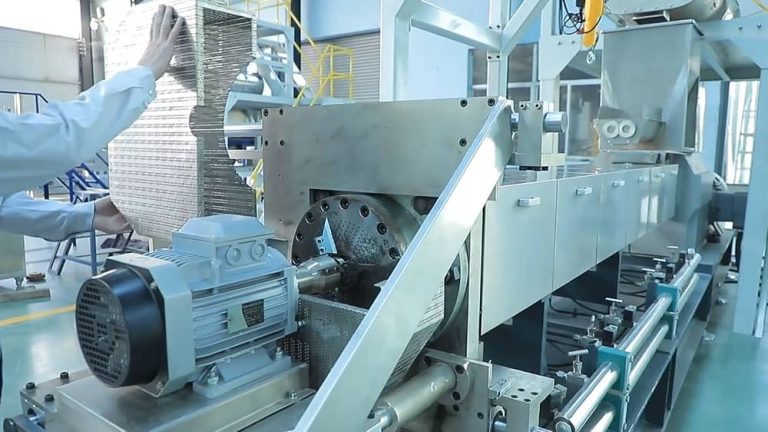
A major design advantage of Zhuoheng twin-screw extruders is our splined shaft with modular screw elements. Because mechanical abrasion concentrates heavily in the final high-shear discharge zone (the last 3 to 4 L/D length before the die plate), the feeding and conveying zones experience minimal wear.
Instead of replacing a single, expensive solid screw shaft (costing $10,000+), Zhuoheng’s modular design allows technicians to slide off and replace only the worn kneading blocks and discharge elements at the front of the shaft. This targeted maintenance approach reduces spare parts costs by up to 70% and cuts downtime from days to just 4 hours.
Frequently Asked Questions (FAQ)
1. When should I replace twin screw extruder barrel liners?
Barrel liners should be replaced when the radial clearance gap between the screw flight and the inner liner wall exceeds 1.5 mm to 2.0 mm, or when the thread flight thickness has worn down by more than 0.3 mm. Operating beyond this limit causes severe material backflow, unstable product density, and high energy waste.
2. Can I replace individual worn barrel segments without replacing the entire housing?
Yes. Zhuoheng extruders feature segmented, multi-zone barrel assemblies equipped with replaceable bimetallic inner sleeves. If wear occurs in a specific high-pressure barrel zone, operators can unbolt that section and replace only the internal bimetallic bushing, preserving the outer heated housing structure.
3. Why does screw wear occur faster near the discharge die?
The discharge zone experiences the highest temperature, internal hydraulic pressure (up to 15–20 MPa), and mechanical shear stress required to force the viscous dough melt through the die plate orifices. This combination of intense friction and pressure accelerates localized metal erosion compared to the cold feed inlet zone.
Maximize Your Extruder Life with Genuine OEM Parts
Extending the service life of your extrusion line requires a combination of proper operational discipline, routine clearance checks, and high-grade metallurgy. Zhuoheng maintains a global inventory of genuine 38CrMoAl nitrided screw elements, bimetallic alloy bushings, and die plates ready for express international delivery. Contact our field service team today to order an inspection toolkit, schedule technical maintenance, or upgrade your machine to high-durability bimetallic liners.