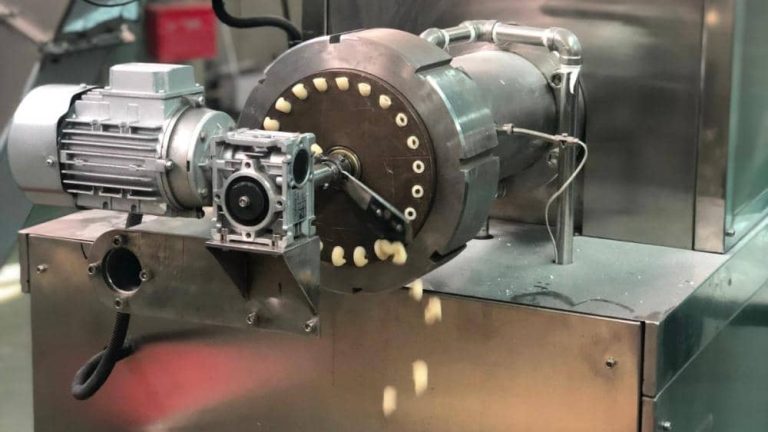
Engineering Authentic Italian Pasta Quality at Industrial Scale
Manufacturing premium commercial macaroni and short pasta (elbows, shells, spirals, penne) is a precise mechanical science. Unlike expanded snacks or kibble, high-end pasta demands continuous flour hydration, uniform dough kneading, complete air bubble extraction, and controlled low-temperature extrusion. Utilizing 100% durum wheat semolina flour and warm water, Zhuoheng’s industrial pasta extrusion lines deliver translucent, golden pasta with a smooth, bubble-free surface and extraordinary cooking resistance—guaranteed to hold an authentic “al dente” bite without breaking or turning broth cloudy even after prolonged boiling.
Key Takeaways / TL;DR
- Bubble-Free Glasslike Matrix: Integrated -0.08 MPa negative pressure vacuum system completely extracts micro-air pockets prior to extrusion, preventing surface checking and transport breakage.
- Superior Cooking Resistance: Gentle cold extrusion (30°C–50°C) protects the durum wheat gluten matrix, allowing macaroni to boil for up to 45 minutes without collapsing, swelling, or clouding the soup.
- Versatile Die Shaping: Rapidly swap Italian-crafted bronze dies (for sauce-holding rough textures) or Teflon-coated dies (for smooth, glittering surfaces) to manufacture over 50 pasta shapes.
- Zoned Low-Temperature Dehydration: Continuous multi-layer belt dryers slowly extract core moisture under controlled humidity curves (55°C–75°C), ensuring long shelf life without structural stress.
Overcoming Processing Defects: Micro-Bubbles and Cloudy Broth
Two primary defects plague low-end commercial pasta: micro-bubbles trapped inside the extruded dough and rapid starch leaching during boiling. Traditional non-vacuum extruders or high-shear systems overheat the flour and trap microscopic air pockets within the starch-protein matrix. During multi-layer drying, these trapped air bubbles expand, creating micro-fractures (checking) that make dry macaroni fragile during transit. Furthermore, when consumers boil the pasta, these porous air pockets allow starches to rapidly leach out into the pot, causing the cooking water to turn thick and cloudy while leaving the pasta soft, sticky, and mushy.
Zhuoheng solves these challenges at the molecular level through a two-fold engineering strategy:
- Low-Shear Cold Extrusion (30°C–50°C): Utilizing a specialized single-screw profile operating at low RPMs, the dough is gently compacted and matured without frictional heat, preserving the raw starch granules and wheat gluten network.
- Continuous -0.08 MPa Vacuum Degassing: Integrated directly into the kneading chamber before the die head, a closed-loop negative pressure pump continuously extracts all microscopic air pockets, producing a dense, glass-like translucent dough matrix.
Extrusion Mechanics Comparison: Single-Screw vs. Twin-Screw
A common misconception among new pasta factory investors is assuming twin-screw extruders are superior for all food processing. In industrial pasta manufacturing, the opposite is true:
Raw Material Versatility and Ingredient Matrix
Zhuoheng TXF series single-screw extruders feature double-screw forced feeding units with photoelectric sensor tracking, ensuring starvation-free dough delivery across diverse grain formulations:
- ✔️ 100% Durum Wheat Semolina: High protein and carotenoid content for natural golden color and maximum gluten strength.
- ✔️ Standard Hard Wheat Flour: Blended formulations for cost-effective commercial macaroni lines.
- ✔️ Gluten-Free Rice & Corn Flour: Precision temperature jacket control allows processing non-gluten matrices for specialty health pasta.
- ✔️ Tapioca & Potato Starch Additives: Customized starch blends to fine-tune elasticity and transparency.
- ✔️ Purified Warm Water Dosing: Automated liquid metering achieving precise 28%–32% pre-extrusion dough hydration.
Versatile Geometric Shapes via Precision Dies
By swapping the front-end extrusion dies, factory operators can produce over 50 classic and modern short pasta geometries on a single continuous line:
- Elbow Macaroni & Tubular Pipes: Hollow curved elbow tubes and straight penne with uniform wall thickness that resist collapsing during extrusion and drying.
- Fusilli & Rotini Spirals: Well-defined, sharp spiral ridges cut cleanly by variable-speed V-belt rotary knives, maximizing sauce-retention capabilities.
- Conchiglie Shells & Specialty Forms: Deeply cupped shell geometries, wheels, alphabets, and flat lasagna sheets with smooth or ridged surfaces.
“Upgrading to Zhuoheng’s TXF-200 vacuum macaroni line eliminated our surface cracking issues entirely. Our elbow macaroni now holds a crystal-clear appearance, and our customers love the firm al dente texture.” — Marco G., Operations Director (Italy)
Technical Specifications and Production Capacities
The table below outlines Zhuoheng’s TXF series single-screw macaroni extruder models, backed by verified factory data and international engineering standards:
Frequently Asked Questions (FAQ)
Q1: Why is a single-screw extruder preferred over a twin-screw extruder for premiires low expansion and high compaction), or heat-sensitive High-Moisture Meat Analogs (HMMA)? Each application requires distinctly different shear profiles, screw geometries, and barrel temperature configurations.
2. Decoding the L/D Ratio (Length-to-Diameter)
The L/D ratio is arguably the most fundamental metric of any twin-screw extruder. It defines the length of the processing section relative to the screw’s diameter. This ratio directly determines how long the material stays inside the barrel (residence time) and the total volume of thermo-mechanical energy that can be applied to the formulation.
L/D Ratio Application Guide
| L/D Ratio | Ideal Product Application | Key Processing Benefit |
|---|---|---|
| 16:1 to 20:1 | Puffed snacks, corn flakes, bread crumbs, basic TVP | Short residence time, rapid energy transfer, explosive expansion at the die |
| 24:1 to 28:1 | Premium pet food, floating & sinking aqua feed, aquatic feed | Balanced shear, extended moderate cooking, excellent control over final pellet density |
| ≥ 32:1 | HMMA (Plant-based meat), Modified API starch, reactive extrusion | Extended thermodynamic cooking, intense protein denaturation, complex molecular cross-linking |
3. Evaluating the Power Transmission System and Metallurgy
The heart of an extruder’s mechanical reliability is its gearbox and thrust bearing assembly. Processing tough, viscous materials like dense pet food or reactive industrial starch generates immense axial back-pressure (often exceeding 20 MPa). Ensure your manufacturer utilizes high-torque distribution gearboxes capable of withstanding severe, continuous 24/7 loads without overheating or gear stripping. Zhuoheng integrates proprietary precision gear designs with automated forced-lubrication and cooling systems to guarantee long-term, fail-safe stability.
Metallurgy Matters: The screws undergo extreme abrasion and corrosion. Zhuoheng utilizes specialized alloy steels (such as 38CrMoAl) combined with deep nitriding treatments to drastically extend the life of these wear parts, thereby reducing your replacement frequency and minimizing maintenance downtime.
Frequently Asked Questions (FAQ) About Selection
Should I buy a single-screw or a twin-screw extruder?
Twin-screw extruders offer vastly superior distributive mixing, can handle significantly higher fat/moisture inclusions (up to 22%+ fat), are highly self-cleaning, and provide much greater flexibility for complex recipes. Single-screw extruders are more cost-effective but are strictly restricted to simpler, low-fat carbohydrate products or specific low-shear applications like traditional pasta.
Related solutions: Industrial Twin & Single Screw Food Extruders | All Turnkey Extrusion Solutions
Further reading: Chinese Twin-Screw Extruders vs. European Brands: Performance, Metallurgy & Cost Comparison