The Commercial Shift in Plant-Based Meat Production
The global plant-based protein market is undergoing a massive structural shift. Consumers and top-tier culinary brands are rapidly moving away from traditional, dry Textured Vegetable Protein (TVP) towards premium High-Moisture Meat Analogs (HMMA). Unlike spongy TVP, HMMA perfectly mimics the authentic muscle fibers, juiciness, and “bite” of real chicken, pork, or beef. For food manufacturers, mastering HMMA unlocks access to significantly higher profit margins. However, the technical challenge is immense: it requires injecting massive volumes of water into plant proteins (like soy, wheat, or pea isolate) and applying extreme mechanical shear without burning the product or destroying its nutritional profile.
Key Takeaways / TL;DR
- Moisture is Key: Authentic HMMA production requires a continuous moisture content between 50% and 70%, necessitating specialized twin-screw extruders with high L/D ratios and advanced liquid injection pumps.
- Cooling Die Technology: The realistic, fibrous meat-like texture is not formed inside the hot extruder barrel. Instead, it is cross-linked, aligned, and solidified within a highly specialized, temperature-controlled long cooling die.
- Precision Control: High-torque gearboxes and highly responsive PLC-based temperature profiling are mandatory to maintain the delicate thermodynamic balance required for protein texturization.
The Zhuoheng HMMA Engineering Solution
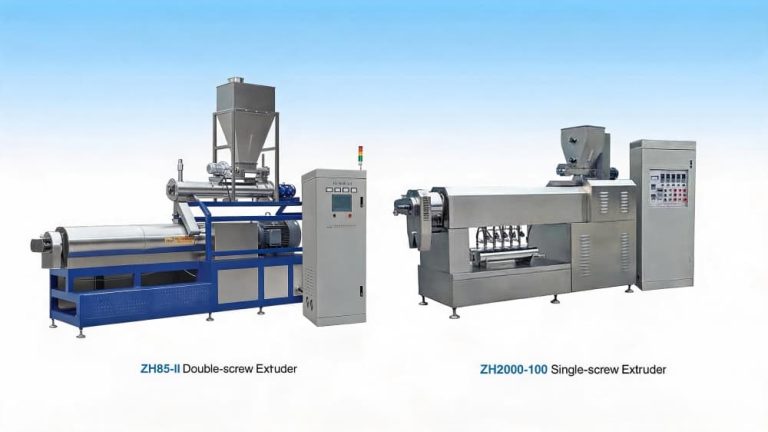
Producing industrial-scale HMMA requires equipment far more sophisticated than standard food puffing extruders. Zhuoheng Machinery has engineered a dedicated HMMA twin-screw extrusion line designed precisely around three core technological pillars:
- High L/D Ratio Twin-Screw Extruder: We utilize an extended barrel architecture (featuring an L/D ratio of 28:1, 32:1, or higher). This crucial length provides sufficient residence time for the raw protein isolates to fully unfold, denature, and homogeneously mix with injected water under immense pressure.
- Advanced Thermodynamic Cooling Die: This is the secret to HMMA. Instead of exiting into the air and expanding (like a snack), the pressurized, molten protein matrix exits the barrel directly into a specialized water-jacketed cooling die. Under strict thermal control, the laminar flow forces the protein molecules to dynamically align parallel to the flow and cross-link as the temperature drops, locking in the distinct “meat tear” fibrous structure.
- High-Torque Power Transmission: Pushing a 60% moisture, highly viscous protein melt through a restrictive cooling die demands massive mechanical energy. Zhuoheng systems are equipped with reinforced, heavy-duty gearboxes and premium thrust bearings to sustain continuous high-torque operations safely.
TVP vs. HMMA Extrusion Parameters
| Processing Parameter | Standard TVP (Dry Texturization) | HMMA (High Moisture Texturization) |
|---|---|---|
| Operating Moisture Content | 15% – 30% (Low hydration) | 50% – 70% (High hydration) |
| Extruder L/D Ratio Required | 16:1 to 20:1 (Shorter residence) | ≥ 28:1 (Extended cooking time for denaturation) |
| Die Configuration | Standard face-cutting die (Expands instantly) | Long thermodynamic cooling die (No expansion allowed) |
| End Product Characteristics | Dry, spongy, requires hydration before use | Wet, fibrous, ready-to-eat/cook exactly like fresh meat |
Launch Your Premium Plant-Based Meat Business
Transitioning a food processing facility to HMMA production positions your brand at the absolute forefront of the alternative protein boom. Zhuoheng provides comprehensive, turnkey industrial solutions—from specialized raw material mixing and hydration systems to the final fibrous meat analog output—backed by our deep expertise in extrusion formulation and installation.